Monday, May 11, 2020

The Enid-In the Region of the Summer Stars (1976)


If there is one group that took the definition of progressive rock to its absolute limit, it is undoubtedly The Enid. They knew how to craft works with the structure and sound of classical music, without merely resorting to a fusion of classical and rock.
The Enid composed music that possessed the structure and ambition of classical music—sounding, in fact, like classical music—yet it was masterfully performed by a rock ensemble.
Their debut album, *In the Region of the Summer Stars* (1976), became a hallmark of progressive rock, earning the band a cult following within the genre.
This first album by The Enid bears more resemblance to the music of Ennio Morricone than to the "typical" progressive rock of the 1970s. Classical music reinvented? Perhaps. Indeed, as you listen to its 39-minute duration, scenes and snippets from films come to mind, brought to life through grand, sweeping orchestration, fluid guitar lines, dreamlike piano, and flute passages. The mood shifts frequently—swinging from the epic, grandiose, or even terrifying, to moments of complete tranquility and calm—creating a true dance of emotions.
A sense of warmth is captured in "The Lovers" and "The Sun"; a spirit of adventure and epic scale emerges in "Fool/The Falling Tower" and "The Devil"—the latter featuring particularly unsettling atmospheres—while the climactic, chilling intensity is evoked in "The Last Judgement" and "Death". Together, these tracks reveal the exceptional quality and inspiration behind this record. Had it been released a few years earlier—and had they not been forced, for absurd legal reasons, to re-record the album for a CD reissue—The Enid and their mastermind, Robert John Godfrey, might not have experienced such a turbulent career. Had any of these factors been different, The Enid would undoubtedly be regarded as one of the premier progressive bands of the 1970s. They might even have had a second chance at success; they belong to an elite group of bands—alongside the likes of Genesis, Yes, King Crimson, and Gentle Giant—that forged a unique, distinctively their own style during that decade, one that is instantly recognizable as such.
Quite simply, no other band managed to bring together such a combination of classical music techniques and styles, high-level technical and musical proficiency, and such emotional breadth and depth as The Enid did.

Klaus Schulze-Mirage (1977)

"Mirage" was Klaus Schulze's eighth album, released in 1977. Like his previous works, Timewind and Moondawn, it features only two long tracks, showcasing visionary music centered around mental imagery. Here, Schulze again displays a wide array of different analog synthesizers, such as the non-modular Moog, Farfisa, and Mellotron.
The result is sumptuous, a cerebral and emotional exploration through time and space that begins with "Velver Voyage", a cosmic journey where strange sounds and profound, ethereal synthesizer contrasts are accompanied by a menacing bassline. In the second track, "Crystal Lake", Schulze delivers one of the most brilliant pieces of progressive electronic music ever recorded, replete with celestial, repetitive, and dreamlike melodies, enveloping much of the composition in a hypnotic and, at times, terrifying state. In “Mirage” the German musician crafted a wide range of abstract electronic sounds that are progressively incorporated to create an imaginary, progressive, fascinating and unique music.

Yes-The Ladder (1999)

The Ladder would be Yes's eighteenth album, released in 1999 and for many the most solid work that the band would release in the nineties.
As a curiosity here the lineup is made up of six members instead of the usual quintet, once Billy Sherwood joins the group as second guitarist along with Steve Howe, likewise Rick Wakeman would be replaced by keyboard player Igor Khoroshev as official member (Maybe the best keyboard player Yes has had since Rick Wakeman or Patrick Moraz, effective, fast, and compliant, his style being a mix between Wakeman and Kaye).

The Ladder is a magnificent effort to recover the classic sound of the band from the 70s, and is demonstrated in songs like New Language, remembering the best Yes, a nod at first to songs like Parallels, Siberian Khatru or Tempus Fugit, brilliant Hammond de Khoroshev to introduce it, quite reminiscent of Moraz on how to digitize the keys. Howe and Squire produce a frenetic rhythm, which White follows, using more resources and speed than the rest of the disc. Everything suddenly drops, and the magnificent voice of Jon Anderson enters, reaching a brilliant "in crescendo" of the instruments, commanded by Howe, again Khoroshev performs brilliant arrangements ..., this DOES sound like Yes of the best time.

Conspiracy-The Unknown (2003)

Conspiracy is one of the multiple side projects of Yes components, in this case by Chris Squire and Billy Sherwood.
Since 1989 Squire would start to compose songs for a solo album, however later on he would meet Sherwood with whom he would begin to compose songs (one of them even went to the album Union de Yes and others were presented with The Chris Squire Experiment .
Sherwood would later go on to enter Yes and record the albums Open Your Eyes and The Ladder, which would make it easier for him and Squire to continue composing for the release of this album in 2003.
On the album, Squire's distinctive style with bass and vocals stands out, while Sherwood is used with guitars, keyboards and vocals.

An album with a style of the Yes of the 80s and 90s, with a clear orientation to sophisticated pop and accessible arrangements but of great quality with some passages of progressive rock.

Step Ahead-Step Ahead (1982)

Step Ahead was an ephemeral French progressive rock band (not to be confused with the Steps Ahead jazz rock super band founded by Michael Brecker and Mike Mainieri).
With just a few years of activity, this band would publish in 1982 their only and acclaimed album by the European specialized critic.
His style with the hallmark of symphonic rock from the 70s was his most notorious influence, fused with classical influences and the keyboards of the eighties, with very complex layers of semi-classical keyboards and very good work of guitars and voices together.
This unique album "Step Ahead" (1982) has been reissued several times due to its great popularity

This work would be a clear advance to what a few years later would be coined as Neo Progressive.

Jethro Tull-Stand Up (1969)

After the album This Was, Jethro Tull would have his first great change of formation integrating the guitarist Martin Barre, who would be a fundamental piece in the entire trajectory of the band in the following years.
If This Was was already a resounding success, it was still an album with strong blues influences directed by Mick Abrahams, undoubtedly who more and better managed the band's paths towards delicious sounds of progressive jazz-blues with folk streaks.
On the Stand Up album, Ian Anderson would totally take over the reins of the group, launching the group's career towards new musical challenges, with a more robust, melodic production and showing influences from classical as well as rock, folk, ethnic, without forgetting jazz roots. and blues.

On the other hand, the integration of Barre endows the band with a harder sound in the group's medieval style, immersing the music of Jethro Tull in one of the standards of world progressive rock.

Sandrose-Sandrose (1972)

For many, the first and only work of the French Sandrose is one of the hidden jewels of the European progressive, a work that is coveted by collectors and that today, in addition to being difficult to obtain, is a disc with a fairly high value.
Sandrose was a great French prog rock band, formed in 1971 by guitarist Jean Pierre Alarcen. The other members of the band were Christian Clairefond on bass, Michel Jullien on drums and Henri Garella on keyboards and Mellotron. Voices were supplied by powerful vocalist Rose Podwojny singing with English lyrics.

In this unique album we can see some beautiful dialogues between the majestic guitar and the splendid keyboard sounds, with excellent melodies illuminated by a powerful but at the same time subtle voice.

Ram Jam-Ram Jam (1977)


Ram Jam was a legendary blues-rock and hard rock band from the 70's, whose members included a former Lemon Pipers member, Bill Bartlett.
On the American East Coast, Jerry Kasenetz and Jeff Katz, the masters of bubblegum 60's and heads of Buddah Records, produced in Epic the debut album of hard and blues-rock eponymous Ram Jam (1977), which had little to do with their raids on the previous decade with Ohio Express or the Lemon Pipers themselves. On the album was the danceable and well-known single Black Betty, a song based on a Leadbelly theme that brought a queue, which came as a pearl to the Ram Jams, since several organizations wanted to remove the single from the album claiming that its text was an insult to black women.
The point is that Black Betty would become a worldwide hit of biblical proportions.
Some time later, Tom Jones, one of the great versioners of the story together with Joe Cocker, included the song in his “Reloaded”, taking it to the list of half the world. A year later the Ram Jams released Portrait of the artist as a young ram (1978), another collection of catchy guitar-exploding hard rock tracks, including “Please Please (Please me)”, “Gone Wild”, “Saturday night ”Or the ballad“ Turnpike ”. After the album and without finding a successful single like Black Betty in it, the group ended up separating.

Boston-Third Stage (1986)

In 1986 Boston (more specifically its founder and leader Tom Scholz), had won its legal war against the CBS company, a confrontation that would take six years of litigation.
Once finalized in contract with the CBS, it would be the MCA the one that would publish the new and third work of the band titled Third Stage.
In this album the band closed its golden stage and kept its great surround sound strong based on powerful and melodic guitars, great choirs and vocal performances as well as memorable and anthological guitar solos, in addition to an exquisite production.
It had three magnificent singles, the power ballad Amanda, which would reach number one on the charts, We´re Ready a great hard rock song, and the fantastic Can´tcha Say-Still In Love where Brad Delp excels overwhelming.

In general, the entire album is an outstanding work with notable themes such as Cool the Engines, or Hollyann that sometimes recalls the classic More Than a Feeling.

Orion the Hunter-Orion the Hunter (1984)

Barry Goudreau was one of the pillars of Boston in his first acclaimed albums (Boston and Don´t Look Back), however after the latter he decided to pursue a solo career that he would endorse in 1980 with his first album which is a logical continuation to the classic Boston sound.
In 1984 he would form his own band in which Brad Delp and Fran Cosmo also appeared, called Orion the Hunter and publishes his only album that will be remembered as one of the cult works of the AOR of the 80s.

A work that contains all the orthodox ingredients of the genre, great guitar riffs, with a clear connection to his former band, great vocal melodies and spectacular synthesizer arrangements, songs like So You Rari was a very successful single on American FM radio and In general the album had a great commercial reception and great praise at the time.

Badger-One Live Badger (1973)

Badger was an ephemeral band founded by one of Yes's founders, Tony Kaye who released two albums in the early 1970s.
History tells us that Tony Kaye was fired from Yes shortly after the band's first North American tour in 1970. Differences from the rest of the group had increased with Steve Howe's entry. The relay as you all know was Rick Wakeman.
After his adventure with Peter Banks in "Flash", Tony Kaye forms the band together with bassist and vocalist David Foster who had coincided with Jon Anderson in "The Warriors" and later collaborated on some Yes songs. As a drummer we have Roy Dike (Ashton, Gardner and Dyke) and as guitarist Brian Parrish (Parrish & Gurvitz). Their first album, "One Live Badger", was released in 1973 and for their second LP, "White Lady" (1974), the band had been restructured with the entry of bassist Kim Gardner, guitarist Paul Pilnick (Stealers Wheel) and singer Jackie Lomax.

Their first recording was recorded live at London's Rainbow Theater in 1972. The group was supporting Yes precisely and the record company they shared was recording what would later be the triple album "Yessongs". Co-produced by Jon Anderson and Geoffrey Haslam, and with cover by Roger Dean. As for his music we have progressive rock mixing sounds from Yes, Manfred Mann and even Barclay James Harvest. Great work by Tony Kaye, especially with Hammond, and guitarist Brian Parrish.

Camel-Moonmadness (1976)

In 1976 Camel published Moonmadness, his fourth studio album, which was the last work of the main sequence of the first three and the last of the original line-up (Latimer, Bardens, Ferguson and Ward), undoubtedly the most solid and important of the group.

Moonmadness is a more pleasant and accessible album than the previous three, but at the same time it is an album that reflects a great influence of the Canterbury sound and a different characteristic and it is the processing of sounds, both in voices and on keyboards, which reflects A certain air of electronic experimentation that would no longer be repeated by the group in the following works. Themes such as Song Within a Song demonstrate the brilliance of the album, contributing two different concepts in the same song, first by Latimer and then by Bardens.

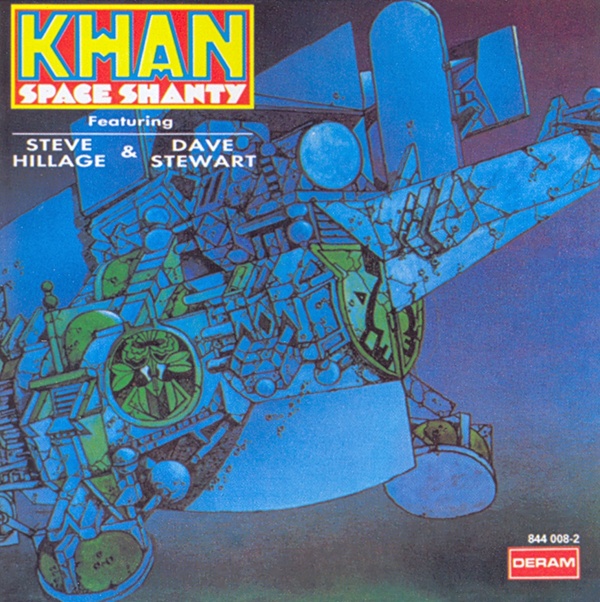
Khan-Space Shanty (1972)

Khan is still one of the bands of the so-called Canterbury sound that is most unknown to the general public at present and unfairly they are never included among the major bands of the genre.
Founded by guitarist Steve Hillage and keyboard player Dave Stewart, his contribution to progressive rock was essential in the early 1970s.
With a single recorded album (Space Shanty, 1972), the group (in addition to the founders was formed by bassist Nick Greenwood and drummer Eric Peachy), they would make a record with a very light-dark sound with many textures ranging from melodious rock to harder sounds, all with a psychedelic and hippie flavor.
However, although as I have said before today they are quite forgotten, at the time the album was very well received by fans of the Canterbury sound
Throughout the album Hillage's great guitar and Stewart's Hammond organ stand out.

Several years later Steve Hillage would publish Fish Rising (1975) which is considered as the logical continuation of this album.

Pete Sinfield-Still (1973)

In 1973 a curious album signed by Pete Sinfield and most of the members of King Crimson with the exception of Robert Fripp would be published.
Among the musicians that would participate were Mel Collins, Greg Lake, John Wetton, Boz Burrell, Keith Tippet or Ian Wallace among others, that is to say, all of them former components of King Crimson in some of its multiple formations.
This album titled Still gives a clear idea of how KC would sound without its leader, Fripp, music with many verses, layers of delicate and ethereal sounds, elaborate sounds and very close to the most elemental symphonic rock of the late 60s

The album happened without penalty or glory commercially speaking and Sinfield would abandon his solo career to dedicate himself to production in the following years, even so the album became one of those cult albums within the progressive scene.

Santana-Caravanserai (1972)

Santana's fourth album would mean the stylistic breakdown of the band on a commercial and famous level.
Caravanserai (1972), radically contrasts with previous albums based mainly on the fusion of Latin sounds and rock, here in this new album, Santana focuses on jazz and progressive sounds.
Most of the songs were instrumental and consequently there were no singles on the hit charts.

This would be the first album in a series of works with a more complex and reflective character focused on jazz rock, for many critics of the time it is the best album of the group, which nevertheless contrasts with the artistic success, since it was not accompanied of the sales of his predecessor albums, losing followers of his Latin style on the one hand and gaining on the other a segment of fans of progressive rock.

Barclay James Harvest-Barclay James Harvest (1970)

The first album by Barclay James Harvest labeled the band in the purest tradition of the progressive of the late 60s and early 70s.
Wrongly referred to the footnotes of rock history, considering them a copy of The Moody Blues by the British press, they were active for more than a quarter century with a practically intact formation and achieving success in many European countries such as Germany where they are revered.
Their debut album published in 1970, manages to integrate classical sounds much better than other bands of the same time, with great orchestral arrangements full of details, with a wise mix of folk, classical and art rock music, baroque keyboards and Mellotron accompaniments, and they even dare to experiment well demonstrated in subjects like the dense "Dark Now my Sky".

The Moody Blues-In Search of the Lost Chord (1968)

This album is a clear example of how germinal progressive rock was, an album where the foundations of what a few years later would come to explode as the most successful genre of the 70s are.
In Search of the Lost Chord (1968) is a concept album about search and discovery, world exploration, philosophy and music through the centuries, lost love, spiritual development and knowledge of a changing world along with space exploration.

An album as sophisticated as complex, that unlike the previous Moody Blues album where the band was accompanied by the London Festival Orchestra, here in this work they decided to play all the instruments themselves, in total a whopping 33 instruments, some of them exotic like the citara, or the tambura, the oboe or the cello.

The Nice-Five Bridges (1969)

Five Bridges is one of the most ambitious works in the history of progressivism, and without a doubt one of the best works of The Nice.
A monumental work divided into 5 parts that plays with the symbolic idea of the musical bridge in various ways.
The composition is part of a commission for the Newcastle Arts Festival in 1969 and it demonstrates Keith Emerson's extensive theoretical knowledge of composition, harmonization and orchestration.
Lee Jackson's texts refer to his memoirs and memories about his native Newcastle where there were five bridges that spanned the River Tyne.

The structural treatment of this work is complex in developments, an idea that Emerson would later translate into EL&P.

The Crazy World of Arthur Brown-The Crazy World of Arthur Brown (1968)

Another of the greats of the underground and progressive scene of the 60s were undoubtedly The Crazy World of Arthur Brown, which had a massive success with the theme Fire, which raised them to the top of the charts in the United Kingdom, in addition to Reach the top of the album charts in the United States and Middle Europe.
But just like what would happen to Procol Harum this single and this album was a burden too difficult to overcome eclipsing the magnificent rest of his career.
But nevertheless Brown's greatest real contribution to rock music was theater; his antics on stage, from wearing a helmet with fire to crucification in addition to his different characterizations and established a standard to follow in the coming years (Peter Gabriel, Alice Cooper or Kiss copied this idea in the 1970s with notable success ).

From this formation Atomic Rooster would emerge some time later with two of its members (Carl Palmer and Vincent Crane).

Hawkwind-Levitation (1980)


In 1980 Hawkwind released his tenth album "Levitation" where he included Ginger Baker as an official member of the band as drummer and also Tim Blake's first from Gong as keyboard player.
Levitation is one of the best works by Hawkwind, with a very balanced sound and a wide variety of instruments that enrich his instrumental palette, with abundant contrasts between heavy guitars and lighter and more spacey synthesizers giving the touch to his unmistakable space rock.
This would also be one of the first albums in history to be recorded entirely digitally.

Saturday, May 2, 2020

Miles Davis-Seven Steps To Heaven (1963)

"Seven Steps to Heaven" is Miles Davis's twenty-ninth studio album, his second recorded under the Columbia label, and the first to feature his famous Quintet, composed of Ron Carter (bass), Victor Feldman (piano), Tony Williams and Frank Butler (drums), Herbie Hancock (keyboards), and George Coleman (saxophone), the latter later replaced by Wayne Shorter, another key musician in Davis's later career. On this album, Davis had not yet begun his transition to jazz-rock/fusion; however, in various passages, the trumpeter ventures beyond classic jazz, exploring avant-garde and experimental sounds. This expansion into more progressive territory is present in the refreshing "So Near, So Far" and in the bluesy melodies "Basin Street Blues" and "I Fall in Love Too Easy", while be-bop jazz appears in the title track or in the swing "Baby Won't You Please Come Home", while "Joshua" is the perfect example of the instrumental talent of the entire band, crafting an excellent and adventurous harmonic jazz melody.

Friday, May 1, 2020

Miles Davis-In a Silent Way (1969)

Hailing from Baton Rouge, Louisiana, Potliquor was a band that released two excellent albums focused on Southern rock, which, however, never received the recognition they deserved due to competition from many more prominent national bands of the time. 
Their beginnings date back to 1969, when singer George Ratzlaff, who also played guitar and keyboards, joined bassist Guy Schaeffer, guitarist Les Wallace, and drummer Jerry Amoroso to found Potliquor. 
Shortly after, a well-known manager from the Baton Rouge area named Jim Brown began representing them and secured them a contract with a local label called Janus Records, with whom they released their first album, "First Taste", in 1970. 
Produced by Jim Brown himself, this debut showcased Potliquor's early Southern boogie-rock style with hints of the rawer sounds of American rock and touches of blues and gospel. 
This debut album contains a series of commendable and interesting tracks, such as the opening southern boogie rock song “Down The River Boogie”, where they showcase their rich vocal harmonies. In “Ol’ Man River”, the band embraces their religious upbringing with a superb gospel performance. Rock and roll infused with Creole sounds appears in “Riverboat”, and the heavy sound of organ and blues is present in the hallucinatory instrumental “Toballby”, which features exuberant percussion in the purest Santana style. The lysergic and acid sounds emerge with “The Raven”, undoubtedly one of the album's highlights, an epic song of dark, psychedelic sounds. The heavy blues rock, infused with soaring gospel choirs, featured on tracks like "You're No Good", the sublime "Price 20 Cents a Copy", and the Stones-esque "Driftin' ", resulting in an album that was well-received and led to a second album three years later, titled "Leeve Blues". This second album followed a similar path but with a slightly more bluesy focus. 
However, these godfathers of Southern rock would not release another album, although they remained active until the late seventies, performing concerts throughout Louisiana, where they had a large and devoted fanbase.

Sunday, February 9, 2020

Scorpions-Love At First Sting (1982)

With "Love At First Sting", the German band Scorpions reached their creative and commercial peak, delivering an album that masterfully balances heavy hard rock and the power of heavy metal, with a series of high-quality songs brimming with melody and accessibility for a wide audience. While their previous albums, "Lovedrive", "Animal Magnetism", and "Blackout", had already created a brilliant sequence of songs full of punch, melody, and catchy choruses, this time they go a step further with their overwhelming, high-intensity tracks. Anthems of generations of heavy metal such as "Rock You Like a Hurricane", "Bad Boys Running Wild", "Coming Home", "Big City Nights", "Crossfire" or the eternal ballad "Still Loving You", propelled this ninth album by the band formed by Klaus Meine, Rudolf Schenker, Francis Buchholz, Herman Rarebell and Matthias Jabs to the top of the charts in numerous countries and as a result, multimillion-selling worldwide.

Tuesday, December 31, 2019

Blue Oyster Cult-Fire Of Unknown Origin (1981)

After the mediocre album "Mirrors", Blue Oyster Cult needed to revive their career, a trajectory that had elevated them to the pantheon of rock music with superb hard rock and psychedelic albums in the first half of the 70s. To this end, they set to work and decided that their next projects would feature Martin Birch, who would take the reins of production and push them back to the level they deserved. "Cultosaurus Erectus", released in 1980, recaptured some of that essence with an impeccable sound where the instrumental passages once again became the band's main attraction. But it was with their next album, "Fire Of Unknown Origin", that they would definitively rise from the ashes with a masterful record, where keyboards take center stage to create a dark yet highly effective atmosphere. Fans received this album with great enthusiasm thanks to tracks like the melodic "Burnin' For You" or "Joan Crawford", the rhythmic "Veteran of Psychic Wars", the frenetic "After Dark", the hard rock "Heavy Metal: The Black and Silver" or the old-school "Sole Survivor", songs with which they returned to the sounds they left behind with the album "Spectre" and expressed their intentions about the path to follow.

Monday, December 23, 2019

Vangelis-Voices (1995)

In the 1990s, Vangelis finally abandoned the experimentation he had displayed in his work during the 1970s and 80s, years in which his symphonic avant-garde style permeated most of his compositions. At this point, the Greek musician based his style on ethereal music, built on more grandiose chords, with superb orchestral arrangements and lyrical choirs, which, far from being pretentious, are simply the result of his many years of continuous experimentation. With his twenty-seventh album, Vangelis takes a further step, giving the human voice a prominence never before seen. Navigating between melodic sounds and soothing new-age music, Vangelis presents a series of atmospheric and fluid pieces, with beautifully haunting lines and an omnipresent mysticism. This time, he enlists the collaboration of various voices, including Caroline Lavelle, Stina Nordenstam, the Athens Opera Chorus, and singer Paul Young. Pompous pieces like "Voices" contrast with the ethereal atmospheres of the Celtic "Come To Me", the beautiful melody of "Ask The Mountains", the evocative "Losing Sleep (Still My Heart)", the paradisiacal "Prelude", and the spacey "Dream In An Open Place".

Wednesday, December 18, 2019

Johnny Winter-Johnny Winter (1969)

In the late sixties, guitarist Johnny Winter definitively joined the small group of white musicians who were driving the electric blues movement. Names like Mike Bloomfield, Canned Heat, John Mayall, and Al Kooper, among others, had already begun to master the restricted core of blues as Black music and started to popularize it among a massive white audience. Johnny Winter, for his part, had been in San Francisco for some time, where he had collaborated with Janis Joplin and Quicksilver Messenger Service, but his stay there was short-lived. His desire to evolve led him to New York, where he met Jimi Hendrix himself, who secured him a lucrative contract with Columbia Records. All of this culminated in Johnny Winter's debut album, recorded in Nashville and titled "Johnny Winter" (1969). On this first album, the guitarist collaborated with his brother Edgar and the legendary bluesmen Willie Dixon and Sharkey Horton. Here, the guitarist presented his credentials at the peak of his talent, unleashing a torrent of energy and performing both his own compositions interspersed with covers. The visceral blues-rock track "I'm Yours and I'm Hers" is a declaration of intent and a masterpiece of slide guitar, while other songs like the raw hard rock blues "Leland Mississippi Blues" contrast with the acoustic blues of "Dallas". Among the standout covers are B.B. King's "Be Careful With a Fool", which Winter transforms into a powerful and carefree blues, Ray Charles' rhythm and blues ballad "I'll Drown in My Tears", and his brilliant rendition of the traditional rural blues "Good Morning, Little Schoolgirl". This debut album by Johnny Winter is undoubtedly his masterpiece, the work that would forever cement his place as one of the greatest bluesmen in the history of the genre.

Monday, December 16, 2019

Charlie Byrd-Brazilian Byrd, Music Of Antonio Carlos Jobim (1965)

Charlie Byrd is one of the legendary jazz guitarists who, throughout his long career, explored countless styles ranging from bossa nova and Latin jazz to swing. In 1965, he conquered the charts and the hearts of millions around the world with one of his most emblematic works, "Brazilian Byrd", a collection of immortal songs by the Brazilian artist Antonio Carlos Jobim. Iconic tracks such as "Jazz 'n' Samba (Só Danço Samba)", "Corcovado", "Samba Do Avião (Jet Song)", "The Girl from Ipanema", and "Dindi" are beautifully framed by captivating arrangements courtesy of Tommy Newson. In all of them, the sound of jazz in the style of bossa nova and lounge music is brilliantly layered with a dreamy trumpet, Byrd's melodic guitar, and the accompaniment of a string, brass, and wind orchestra.

Thursday, December 12, 2019

Screaming Trees-Sweet Oblivion (1992)

Rooted in the grunge sound of the late eighties, Screaming Trees had a difficult start. Their musical vision wasn't always understood by a large part of the general public, and it wasn't until well into the following decade that they began to gain recognition from both the public and specialized critics. "Sweet Oblivion" was their definitive breakthrough, where they definitively left behind their dense, dark rock with psychedelic touches and garage sound, moving towards a hard rock typical of the seventies. This album contains a very attractive collection of tracks such as the superb "Shadow Of The Season", "More Or Less", "No One Knows", "Nearly Lost You", and "Butterfly", together forming their best work, which paved the way for them on the North American charts, reaching a surprising fourth place on the Billboard charts and selling over three hundred thousand copies in the American market alone.

Wednesday, December 11, 2019

Unicorn-Blue Pine Trees (1974)

With a harmonious blend of folk and country rock, Unicorn was an excellent band that, in 1974, gained the approval of guitarist David Gilmour (Pink Floyd), who went on to produce their second album and even play sporadically on it and their next recording. This British group had been performing for several years under different names (The Senders, The Pink Bears, and The Late Edition) before settling on Unicorn. Signed to Transatlantic Records, they released their debut album, "Uphill All the Way", showcasing their distinctive style, which drew influences from American bands like America, Poco, and Crosby, Stills, Nash & Young. A style heavily influenced by American musical roots, blended with the pastoral sounds of British folk, and complemented by harmonious vocals and refined melodies, made "Blue Pine Trees" and its follow-up, "Too Many Crooks", two little gems of the American country/folk rock genre that sadly went unnoticed. This second album features beautiful folk melodies such as "Autumn Wine," "Just Wanna Hold You", "The Farmer", "The Ballad of John and Julie", and "Blue Pine Trees", tracks that perfectly counterpoint the rhythmic country rock songs "Holland", "Nightingale Crescent", "In The Gym", "Volcano" and "Rat Race".

Tuesday, December 3, 2019

Odin-Odin (1972)

Odin were another of those fantastic, short-lived bands that, with only one album released, have become cult progressive rock acts. Founded in the early seventies, these Brits created an admirable work on their sole album, focused on progressive hard rock with influences from the late sixties psychedelic movement. However, since their base of operations was in Germany, they were categorized within the krautrock movement, also due to their avant-garde style driven by heavy guitars and the prominent Hammond organ. The band consisted of keyboardist and vocalist Jeff Beer, guitarist and vocalist Rob Terstall, bassist Ray Brown, and drummer Stuart Fordham. Signed to Vertigo Records, they released their only album in 1972, revealing a style closer to the progressive hard rock of British bands like Deep Purple and Quatermass. The masterful organ and guitar lines predominate in songs like "Life Is Only", while the jazzy "Tribute to Frank", an ode to Frank Zappa, becomes the most hypnotic track on the album. This vein is further enhanced by the atmospheric "Eucalyptus", which leads into a thrilling, progressive cover of Quatermass's "Gemini". The album concludes with the serene folk "Be The Man You Are" and the heavy, dark, psychedelic "Clown". Without a doubt, this album is one of the lesser-known gems of British progressive rock, mistakenly categorized within the German krautrock movement.

Saturday, November 30, 2019

3 - ... To the power of three (1988)

Talking about this work in relation to the work of EL&P is a bit difficult. The project was the idea of ​​Emerson who wanted to continue maintaining the usual structure and try to get a new success despite the disappointment, especially for Greg Lake, the album published with Cozy Powell in 1986. Emerson is not frightened by the march Greg and decides to join his lifelong drummer Carl Palmer and completing the trio with Robert Berry.
It is fair to dedicate some lines to Berry since the life of the other two we already know. His professional start was in San Francisco with the band Hush that allowed him to open people like Peter Gabriel or Rush. After two solo albums, "Back to back" and "Out of bounds" joins the GTR group after the departure of Steve Hackett, but the fear that he would end up supplanting vocalist Max Bacon, did not define the thing. It should be noted that before this there was already a group project between Palmer and Berry that did not finish working.
Berry is a leading vocalist and guitarist, but also a composer and producer, he has composed some soundtrack and has participated with groups such as Magellan (in his album “hundred year flood” where musicians such as Tony Levin or Ian Anderson also appeared) of being an active part of the different progressive tributes-tributes that the magna carta seal publishes.
Berry was not only a kind of substitute for Greg Lake but was actively involved in the composition of the album, composing songs that Emerson later arranged in his own way. The album also featured the voices of Suzie O'list, Kim Liatt J. Edwards and Lana Williams.
There is also a live show of this formation with themes of E, L & P called “live in the city”.
The album is a clear example of music made in the 80s, digital keyboards, guitars with very clean sounds and loaded with reverb with direct rhythms, as always in this type of compositions, that the simple appearance does not mean that the content is not something more complex and in this album there is a bit of everything: The album begins with “talkin´ about”, signed by Berry who initially wrote it for GTR, a dynamic song with a classic refrain of the time. Follow "Lover to lover" signed by the trio, the song is not bad but the chorus seems a bit scary ... well, rather I would say very trite, it has an instrumental bridge that briefly reminds the seventies EL&P, but this bridge barely lasts a few seconds, no one gets illusions. "Chains" is a song "too much AOR" and therefore of those chosen to click on the radios. "From life" is the song that this album is worth, divided into three parts: I. The view, II. The border and III. Sangre de toro, a piece of authentic progressive pop is created, with instrumental fragments that can be remembered on the one hand to the tangerine dream of the eighties, but it also serves as a relief to Palmer's drums or Emerson's piano. In "Eight miles high" we continue with the AOR sonorities (this actually happens throughout the album), however, the keyboard and guitar flourishes that are marked by Berry and Emerson stand out on a continuous rhythm of Palmer. "Runaway" ... every time I find it more difficult to highlight something of each song, since almost all of them follow a similar pattern and production, of this I will say that it seems the weakest of the album. “You do or you don´t” is the typical ballad that we can find in almost any Hollywood movie of the time, although here Emerson's keyboard arrangements are very remarkable. The album ends with “On my way home” signed by Emerson and well, it does not leave a bad taste, possibly the songs that are closer to the classic EL&P style with production of the time, even highlights the fact that at times it seems even that Robert Berry wants to emulate Greg Lake.
Two things are clear at the end of the listening, that the album connects with what other fellow musicians of the same fifth were doing: Genesis with “invisible touch”, Yes and “big generator”, Pink Floyd with “a momentary lapse of reason” , etc ... and formations such as Asia or GTR, here that each one judges who did it best, since there is no doubt that they are great musicians trying to adapt to the times ...
On the other hand it is clear that the album is not progressive rock, so I think that judging it from this perspective is unfair, it is a nice album, superbly produced and competently composed, ideal for listening when you do not feel like complications but of things well made.

Monday, November 25, 2019

Blind Faith-Blind Faith (1969)

This is the first and only studio production of the group formed by Eric Clapton, Steve Winwood, Rich Grech and Ginger Baker. Historically, this album represents the varied currents that would converge in the development, although ephemeral, of one of the first supergroups in the History of Rock. A halo of excellent creativity, dynamics and virtuosity surrounded the quartet in the rocky world of that time. The group left an imperfect mark with this magnificent album, a true treasure for the reliable connoisseur.
Recorded between February and June 1969, the album begins with ¨Had to cry today´, a splendid melodic proposal in which the Blues-Rock chords dominate the basic structure of the interpretation, It is a melodic proposal, a bridge between Cream and Traffic Almost at the end, we heard 2 electric guitars in arpeggio game. ´Can´t find my way home´, is a commendable, beautiful, nostalgic acoustic manifestation, (great work on the guitar by Clapton), reminding us of what was the rock feeling in the late 60´s and that for some time we had heard with traffic. This piece is sublime, with the voice of Winwood, at times scratchy and others leading us to the falseto. A true seventies experience. ´Well all rigth´, is the classic of Buddy Holly, interpreted in a cheerful, rhythmic way and with an excellent synchrony of the group. Winwood's magnificent work on the piano. Presence of the Lord´, is a masterful, enveloping melody, perhaps the best piece of the album, a work of art, a wonderful Blues, Winwood stands out with that vocal tone so own along with a beautiful piano performance,. ´Sea of ​​Joy´, is, surely, the best known piece of the group, since it was very programmed by the world broadcasters in the 70´s. His melodic livelihood is a Blues-Rock, Steve's vocal performance prints a very particular feeling, the acoustic guitar is excellently executed with an active and attractive participation of Grech in the violin, (does anyone remember Family?). It is precisely here that we notice the magnificent Proto-Progressive dyes of the group. A piece perhaps commercial but very well crafted. ´Do what you like´, is a long Jazz-Rock passage, the most elaborate track of the album, finely interpreted that accommodates the individual showcases of musicians with their respective solos, highlighting that of Baker on drums. Winwood also looks on keyboards.
Although with a short life, the quartet forged a unique image, transcendent, very influential a posteriori and as a logical consequence, the album just discussed is an essential elementary Work of Art within the Proto-Progressive genre.

Saturday, November 23, 2019

Yes-Tales From Topographic Oceans (1973)

Even if "Close to the Edge" was a perfect progressive rock album and Yes had stopped making music right then and there, they would still be one of the greatest bands in history and could claim some of the best albums ever to come out of rock music. But what truly cemented Yes's status as one of the greatest bands of all time were the two albums that followed, two unsurpassed records: "Tales from Topographic Oceans" and "Relayer". Both are exponentially deeper than "Close to the Edge" in terms of scope and musical mastery, despite the reservations many fans and even some band members had, especially regarding the former. "Tales from Topographic Oceans" is one of the most magical, powerful, and iconic recordings of all time, and empty criticism born of musical ignorance will never be able to touch it. Musically speaking, this double album offers nearly an hour and a half of Yes's most daring and sophisticated explorations to date: extended solos, legendary vocal harmonies, meticulously arranged instrumental sequences, oceanic soundscapes, and acoustic performances worthy of a true classic. It goes without saying that this is not an album to be enjoyed in a single listen, becoming a unique musical experience each time it is heard. On the other hand, it is controversial. While millions of fans adore it, just as many detest it (starting with keyboardist Rick Wakeman), who has publicly ridiculed it on more than one occasion, leading to the infamous curry incident. Unlike the aforementioned "Close to the Edge", in this case, each track (one on each of the four sides of the album) is a complete piece, not composed of subdivisions with individual titles. The story behind this concept album is suitably dark and indulgent, inspired by a footnote on page 83 of Paramhansa Yogananda's "Autobiography of a Yogi." The album opens with "The Reveling Science of God (Dance of the Dawn)", where Rick Wakeman's keyboards are prominent and Jon Anderson showcases his vocal prowess, accompanied by a wide array of instrumental developments from the rest of the band. The following track, "The Remembering (High The Memory)", has a structure quite similar to the first, with Wakeman's keyboards once again taking center stage. However, the overall composition isn't as powerful as the previous track, resulting in a more uplifting piece. The second disc opens with "Things Ancient (Giants Under the Sun)", where Steve Howe delivers the highlights, developing countless scales on his guitar and creating arabesque sounds, leading into a much more moving and accessible second half. The final track, "Ritual (Nous Sommes du Soleil)", is the most purely rock song, featuring exuberant and dynamic percussion by Alan White, and is particularly impressive live. In short, this is an album where Yes manages to weave grand, dynamic soundscapes from melodic allusions. With the exception of Chris Squire, who is generally rather subdued and has less instrumental weight than usual, the album is perfectly balanced, a work as immeasurable as it is unique, and considered one of the masterpieces in the history of progressive rock.

Camel-Rajaz (1999)

We continue with this Camel album quadrilogy of the last two decades (Dust and Dreams, Harbors of Tears, Rajaz and A nod and Wink)
After his two previous works of conceptual type "Dust and Dreams" and "Harbor of tears" predominantly instrumental albums, Rajaz comes to light in 1999, a magnificent album that is one of his greatest achievements in the musical career of Camel.
The original idea of ​​the album is based on a guide about world music that he gave to Andy Latimer, his good friend and colleague Colin Bass. In the section on Arabic music, there was talk about the "Rajaz", a canteen that the Bedouins murmured during the desert crossings, based on the rhythmic pace of the passage of the camels. This gave rise to one of Camel's best albums, a work full of sensitivity, oriental rhythms (impressive the song “The last encore”), guitar solo as in no other Camel album (“Sahara”, “Lawrence”) , which evokes those monotonous landscapes, but at the same time of impressive beauty, those red sunsets, and those cold nights (listen loudly “Sahara”, think of a sunset with a landscape of reddish sands, close your eyes and travel). 
Andy Latimer himself is responsible for putting the voice to the issues, and this time he sings with a special sensitivity. Predominantly guitar player, who has his old colleagues Colin Bass on bass, an impressive Dave Stewart who on songs like "Three Wishes" or "Sahara" seems to be Andy Ward himself behind the drumsticks, and another regular the band that is the Dutchman of Kayak Ton Scherpenzeel, who for the recording of this album, sent the parts of the keyboards recorded in his studio in Holland, via internet to the USA for Latimer to mix them. And the good thing about Ton has a real phobia to travel by plane. It also has the collaboration of Barri Phillips al cello, which gives a touch of serenity to the album and even sadness (listen to the introduction of the song "Rajaz"). 
The album cover perfectly expresses what we are going to find inside, a world of sensations, poetry, oriental rhythms, smells and warm flavors, in short, a journey through the burning sands of the desert, but that finally reaches its destination, leaving us the feeling that it should never end. 
The production of the disc is perfect. The sound of the impressive album, and the compositions, with their oriental rhythms, with a slight jazz touch at times, are pure anthology. 
Rajaz supposed the return to the old spirit Camel, and it is an album that at first listen makes us vibrate as they did not do it from “Moonmadness” or Rain Dances and to a lesser extent with “Nude”, another album of the majestic band. 
And when we thought it would be very difficult to match or overcome this album, the surprise jumped when some time later they published another jewel: "A node and a winck". Wonderful!.

Camel-Dust And Dreams (1991)

After several years arguing with Decca about the rights of the group and a contract not yet expired, Andy Latimer manages to terminate the contract and, even more importantly, get all the rights over Camel's previous albums. He sells his house in London and goes to the United States where he settled permanently in California and uses his savings to found his own record company, Camel Productions, the idea is to record and distribute his future works and reissue all the previous ones. The latter that might seem less important is not if we consider that we are in 1988 and that a new support for music has just appeared, the CD. All the albums that Camel had sold to date (with Decca) were on vinyl, this means that almost all the Camel CDs that we have at home, all in their remastered versions, are already edited by Camel Productions.
Dust and Dream is a concept album based on John Steinbeck's The Grapes of Wrath book that deals with the first emigrants to the United States. He calls Colin Bass again, who will become “the other” fixed member of the band and Tom Scherpenzel, keyboardist of Kayak and meets with musicians. 
The sound of Camel varies completely to what they had offered in their last works, finally abandoning the failed Alan Parsons sound for FM and returning in part to its origins, a very melodic disc and in some of its parts even atmospheric. The first feeling I had when I heard it (live) was as if it had been composed to support images or even some kind of documentary. The sound of Camel until now had been quite cohesive and homogeneous, despite the undoubted prominence of the Latimer-Bardens duo, especially the latter. The first albums of Camel are the work of a whole group and despite the almost permanent presence of the guitar of Latimer were the keyboards of Peter Bardens who moved the group and gave, especially based on the hammond organ a peculiar duality between Rock aggressiveness and calm and Symphonic developments. 
Dust and Dream is a work thought, composed, developed and executed by Andy Latimer. His guitar acquires an absolute prominence from beginning to end and reaches the point of reinventing his own sound, both that of the band and his own. It is, without a doubt, a work much more symphonic than progressive, calmer than aggressive and that is winning in successive auditions. As for Latimer, his guitar covers the entire album; open, develop and close the themes and its sound also evolves. It continues to extend the notes like no other, in what is already its hallmark, but in general, in many places it is inevitable that names like David Gilmour come to mind. 
The album opens with Dust Bowl, a simple melody of keyboards that gives way to Go West, one of the four songs sung on the album, the "old" voice of Latimer we are reeling the first stanzas on a base of keyboards which finally The guitar is joined by introducing us to the following Dusted Out theme, where keyboards once again star in the theme although this time not only as a mattress but also providing melody with the piano. Follow Mother Road that opens with the unmistakable sound of the guitar of Latimer, is another song sung and one of my favorites on the album, a song that is quickly hummed both in the sung part and the beautiful guitar melody, (classic Latimer sound ) both parts merge at the end of the theme to give way to Needless where atmospheric and ambient sound returns, in fact it is interpreted live with three keyboards (Scherpenzel-Bass-Latimer) and serves to introduce us to the next theme. 
Rose of Sharon is a beautiful song and that may have become the most characteristic of the album due above all to something very unusual in Camel such as vocal games, performed here with great success, both in the contrast between female voices and masculine as in the different melodic developments that overlap. A beautiful and undoubtedly romantic theme. Then they repeat the formula that they had previously made, so Milk n 'Honey is another short theme in atmospheric or environmental line that serves to give way to End of the line, the fourth and last song sung of the album and, which in my It may seem to be one of the weakest parts of the album since neither the vocal melody nor the way of singing it by Latimer seems to me the most successful, as well as the drums that sound very flat and percussioned by very poorly played dishes. 
From here would come what we could call the B side of the disc, the following eight themes are all instrumental and without cuts between them and as a whole they return to the environmental line, perhaps sometimes too much. So Storm Clouds is simply Latimer's guitar on a synthesizer beat that gives way to Cotton Camps. Here we have Camel in its purest form again, the unmistakable guitar, with very few notes in its initial part, to build a melody that will be repeated until the end of the song. It is followed by Broken Banks, which in its scarce 35 seconds develops another short tune of the house to merge with Sheet Rain, where the only thing that stands out is the slight appearance of the flute to link with Whispers that rescues an earlier melody with the keys. Little Rivers and little Rose returns to the previous ambient sound and prepares us for Hopeless Anger, where Camel finally gets disheveled. It is a theme that breaks abruptly with the sound of the previous songs, much more aggressive, and obviously progressive, one of the best songs on the album with a wonderful melody by the Latimer guitar that will remain in our heads during a time and that also includes the melody of the final part of Rose of Sharon, an excellent theme. To finish we would have only the beautiful ending by Whisper in the Rain, a beautiful epilogue for a great album.


Dust and Dream is one of the albums to which I have a special affection for several reasons. They are Camel (and just for that reason it is already a compelling reason), and they are after several years of silence and in which I thought the band had disappeared. For many years it was my favorite album of Camel of the 90s (along with Harbor of Tears) and even today it is / are two of the albums that most commonly sound on my stereo. This is why the easiest thing is that if I want to listen to music without masks or reproaches with this album I have it very easy.

Camel-Harbours Of Tears (1996)

With their twelfth album, “Harbour of Tears”, Camel (and consequently, their frontman Andy Latimer) continued their commitment to creating concept albums, this time focusing on the experiences of Irish immigrants to North America in the mid-nineteenth century, during the dark period known as the Great Famine. Following the narrative thread of a story centered on an Irish family, the album's title refers to the deep-water port located in the town of Cobh, on the south coast of Ireland. While virtually all the lyrics were written by Susan Hoover, Latimer's wife, drawing inspiration from the experiences of her ancestors a detail that adds an emotional dimension to the work the music is clearly influenced by Irish folk and Celtic sounds, which, blended with the band's unmistakable progressive rock style, create hypnotic and emotive atmospheres. The band that recorded this album consisted of Andy Latimer (guitars, vocals, flutes, and keyboards), Colin Bass (bass), David Patton (bass), Mae MacKenna (vocals), John Xepoleas (drums), and string and wind instrumentalists Anita Stoneham, Karen Bentley, Barry Phillips, John Burton, and Neil Panton. Celtic influences permeate most of the album's tracks, from the opening "Irish Air" to the emotive "Harbours of Tears", passing through the idyllic "Eyes of Ireland", the nostalgic "End of the Day", and the exquisite "Running From Paradise". On the more progressive side are the vibrant "Send Home The Slates", the complex "Watching The Bobbins", the orchestral "Coming Of Age", and the extraordinary and exuberant "The Hour Candle (A Song For My Father)". With "Harbours Of Tears", Camel not only pays homage to a fundamental part of human history, but also vindicates the human capacity to endure in the face of enormous difficulties, a powerful reminder that in the most terrible moments, there is always a glimmer of hope for better times to come.

Friday, November 22, 2019

Emerson, Lake & Palmer -Brain Salad Surgery (1973)

1973 would be the year of the great works of progressive rock; it was undoubtedly its golden age, a time when the genre's greatest classics were created. Among many others, Pink Floyd released their masterpiece, "The Dark Side of the Moon", while Jethro Tull launched their monumental "A Passion Play", Genesis achieved their perfect work with "Selling England by the Pound", and other bands like King Crimson with "Lark's Tongues in Aspic", Camel with their debut album, Caravan with their enormous "For Girls Who Grow Plump in the Night", and Mike Oldfield with his extraordinary "Tubular Bells" cemented the progressive genre's place at the pinnacle of rock music.
Emerson, Lake & Palmer, for their part, wouldn't be left behind and released their spectacular "Brain Salad Surgery", the first album they released under their own label, Manticore Records. It was initially going to be titled "Whip Some Skull On Ya", but the name was ultimately changed to the one famously known worldwide. "Brain Salad Surgery" is perhaps the band's most powerful work, where the trio achieves total mastery of their musical coherence and, at the same time, the culmination of their creativity. Emerson demonstrates his mastery of the Hammond organ and his outstanding command of the piano and polyphonic synthesizers. Carl Palmer delivers a solid, fast, and highly complex performance, proving that he was at his peak at that time. Greg Lake enhances the overall sound with his excellent voice, thanks to its subtle and fresh echo, as well as his bass playing, which, with its complexity, perfectly supports the demanding keyboards and drums. "Brain Salad Surgery" is perhaps the band's most powerful work. “Brain Salad Surgery” has an obvious jazz influence, as revealed by the more frenetic and complex piano and drum sections. Interestingly, despite the outstanding technical performance of the three virtuoso musicians, all the tracks are remarkably accessible, melodic, and perfectly structured. Unlike their previous album, “Tarkus”, it is not as experimental or inaccessible. The album also boasts a splendid cover, the work of the renowned artist H.R. Giger, designed in his famous surrealist style, celebrated for its futuristic drawings and dark environments. Giger would later gain worldwide recognition for his work on the film Alien, depicting the fateful eighth passenger of the famous spaceship Nostromo. 
The progressive suite “Karn Evil” is the standout track on this album, with its constant tempo changes and instrumental complexity. The grandiose “Toccatta” is an astonishing exercise in technological experimentation, courtesy of Keith Emerson's keyboards, and the epic “Jerusalem” is a superb re-arrangement, as remarkable as it is legendary. Meanwhile, on the jazzy “Benny The Bouncer”, Carl Palmer showcases his immense drumming skills. On the more melancholic and subdued side, we find the accessible and acoustic “Still...You Turn Me On”, one of the few moments of peace and tranquility on this otherwise aggressive and powerful album. With this work, ELP definitively ascended to the Olympus of the Gods of progressive rock, a work cataloged as one of the greatest contributions to the genre, which would rise among the best and best-selling records on the charts on both sides of the Atlantic and which has been constantly reissued since then with great acceptance by the progressive community and rock fans in general.

Thursday, November 21, 2019

Deep Purple-Made in Japan (1972)

In August of 1972 Deep Purple landed in the Country of the Rising Sun to fulfill the commitment made with his Japanese record label, Warner Pioneer, to record three concerts, from which the tracks would be extracted to make a live album that would serve as a claim for the Japanese market, as they intended to relaunch the group's catalog in the country.
Although at the time the direct ones were not very valued, the group accepted with three conditions: the first was to be able to decide on its publication; the second used his own sound engineer, Martin Birch (Fleetwood Mac, Wishbone Ash, Jeff Beck and later Iron Maiden, Black Sabbath, and a long etc.), who had been working with them from "Concerto for Group and Orchestra"; and the third, to give approval to the team to use in the concerts.
The dates chosen were August 15 and 16 in Osaka, and August 17 in Tokyo.
Roger Glover himself recalls that first visit to Japan as the zenith of his group career. He was proud to belong to it and to be able to travel to another side of the world to do what he liked most in front of 12,000 people in Budokan himself, an enclosure that usually hosted sumo competitions. Then I was 27 years old.
Only "Smoke on the Water" was saved from the first concert because the group was tired on the first day (which was reflected in their performance). In addition, inexplicably, Ritchie Blackmore made mistakes in introducing the song performed the other two days.
On the third day, in Tokyo, even being his best performance, only “Lazy” and “The Mule” were saved because the acoustics were not good (it is worth saying here that more than once it has been said that Budokan is not a appropriate venue for music, although there have been many artists who have recorded their performances in it). As a curious note of this day, say that Ritchie threw his guitar to the public up to three times, since the security of the enclosure returned the instrument twice before not understanding that it was a gift from the musician to the fans.
Therefore, most of the material used to release the album was extracted from the second day, completing the "Highway Star", "Child in Time", "Strage Kind of Woman" and "Space Truckin" septet. Nor Ian Gillan not even Ritchie Blackmore wanted to participate in the mixes, since they were against the idea of ​​a live album. Even the first one told everyone that his would not be a good interpretation because he was affected by bronchitis. It took many years to hear the album to realize how wrong he was.
I literally copy what is said in the book A Purple World by José Galván, which has helped me to write all of the above and whose reading makes me increasingly satisfied to have acquired it. The recordings, published in a double LP under the title "Made in Japan", show along its four faces the skill of the five musicians in seven great pieces that would make this the best-selling live album in history. Without a doubt, this was the group's greatest contribution to the history of Rock music.
To conclude, say that as I write I am listening to the album again and I feel again the emotion I felt the first times I heard it in that cassette. My hair is on end every time I hear Ritchie Blackmore's guitar solo on "Highway Star," Ian Gillan's falsettos on "Child in Time," Ian Paice's drum solo on "The Mule," introduction of "Lazy" by the hand of the master Jon Lord and the bass of Roger Glover, which involves everything. An authentic prodigy of about 75 minutes highly recommended that turns 40 years old.

Pink Floyd- Animals ( 1977)

After the album "Wish You Were Here", brimming with sweet, atmospheric, and ethereal passages, where Richard Wright's keyboards and synthesizers take center stage, came "Animals", a concept album based on George Orwell's "Animal's Farm", in which various groups in society are represented as animals. Dogs represent the law, pigs represent the leaders, and sheep represent the people. Throughout the album, Waters equates humans with each of these three animal species. Although Orwell's novel focuses on Stalinist communism, the album is a critique of the worst aspects of capitalism. With "Animals", Pink Floyd entered their third phase, that of "songwriter rock," where Roger Waters is the band's leader, a group where the lyrics matter as much as, or even more than, the music. "Animals" also represents a shift into a much darker territory than the previously explored, spacey themes that Pink Floyd had rarely touched upon. Whether this was a response to the punk movement or a reflection on English society at the time and the allegorical and sociopolitical/philosophical meaning that Waters was trying to convey, Pink Floyd would once again astonish the world, achieving another masterpiece after two previous albums that were equally impressive and absolute magnum opuses of contemporary music. Composed of three epic, somber, and mysterious tracks "Dogs", "Pigs (Three Different Ones)", and "Sheep" where energetic and heavy rock guitars take center stage, plus two acoustic ballads, "Pigs on the Wing, Part 1" and "Pigs on the Wing, Part 2", Pink Floyd would once again create a masterpiece, following two previous albums that were equally impressive and absolute magnum opuses of contemporary music.

Genesis - Selling England by the pound (1973)

"Selling England by the Pound" is a masterpiece of progressive rock, featuring some of the most perfect compositions of the 1970s. With impeccable production, it showcased Genesis at their creative peak. Here, the band brilliantly combined their pastoral style with rock, creating delicate moments of great beauty interwoven with aggressive and vigorous sections. From the opening track, "Dancing with the Moonlit Knight," whose flute and medieval-sounding guitars make it a symphonic classic, to the catchier and more commercially viable "I Know What I Like (In Your Wardrobe)," and including the epic and eccentric "The Battle of Epping Forest," the memorable "Firth of Fifth," and the monumental and evocative "The Cinema Show," the band displays a high level of virtuosity and instrumental complexity throughout the album.