
Showing posts with label Uriah Heep. Show all posts
Showing posts with label Uriah Heep. Show all posts
Thursday, August 17, 2023
Uriah Heep-Live (1973)

Saturday, November 7, 2020
Uriah Heep-The Magician´s Birthday (1972)
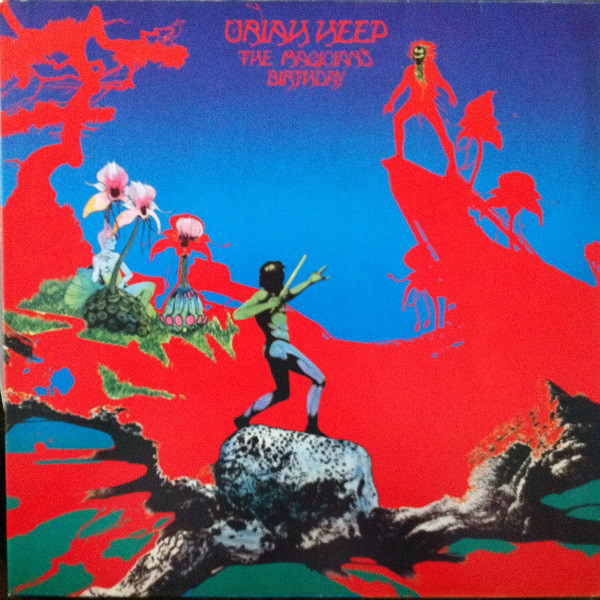
If in the previous work the band had conscientiously worked its sound, taking it to progressive levels, but without taking away an iota of commerciality, here the sounds are even more dense and dramatic, with a less heavy and complex style, placing great emphasis on the facet commercial.
However, none of this detracts from their unmistakable sound while preserving the hallmarks of Uriah Heep that remain unchanged, the beautiful harmonies of "Rain" and "Blind Eye", contrast with powerful rock such as "Sweet Lorraine" the rhythmic "Spider Woman", the emotional "Tales", the anthological "Sunrise" or the progressive "The Magician's Birthday", which make up a masterful album worthy successor to that masterpiece that is "Demons and Wizards".
Monday, August 31, 2020
Uriah Heep-Very´Eavy...Very´Umble (1970)

You just have to listen to the frenetic opening bars of the now classic 'Gypsy' to know that we are facing something very special, Byron's magical tone of voice lets us carry on an accelerated blues dedicated to an enigmatic and bewitching woman. The main riff of this song is one of those that sits chair, simple and direct to the jugular, but the brief final duet between Napier's drums and Box's guitar is simply orgasmic, not to mention the aforementioned and insane screams of Byron, an underrated singer where they exist.
From the hand of the beautiful ballad 'Come Away Melinda', where Byron's melancholic voice takes center stage again, here we have the opportunity to enjoy the great work done on vocal harmonies ( a more arduous task than we normally recognize) by the whole group.
For their part, songs like 'Walking in Your Shadow' or 'Real Turned On' move in less exceptional parameters, but equally valid, continuing with the meandering and bluesy rhythms that populate the corners of this album. Likewise, the final 'Wake Up (Set Your Sights)' is another of the album's high points. With a changing structure, the strength of the song lies once again in Byron's vocal power and in the great atmosphere created by the guitar and keyboards. The rest of the songs may not be as spectacular as those already mentioned, but they do not affect an album too much, which, in itself, is highly recommended only for the historical value that it entails.
Uriah Heep germined the musical experimentation, blues, and a lot of vocal drama that we would find later on all the albums of bands like Yes, Judas Priest or Genesis. There they were Uriah Heep as the spearhead of a movement that, by then, was beginning to awaken. Without being a complete essential, "Very 'eavy ... Very' umble" is crucial to understand not only the sound and the subsequent evolution of the band, but of an entire musical movement.
Distinguished mention and bonus points for the gruesome and memorable cover. The ghostly face is none other than that of singer David Byron with his face covered in dried glue. According to Box himself, Byron took a whole week to remove all the glue. Disgustingly unbelievable, but true.
Wednesday, June 3, 2020
Uriah Heep-Abominog (1982)

They gave a spectacular twist to their style and entered the limits of commercial heavy metal and they would do it with great success, as they well reflected in their album "Aboming", published in 1982.
When it was released, the world of hard rock and heavy metal were surprised with this fantastic album, when practically nobody trusted them anymore. Themes like "Too Scared To Run" became from the first moment as a kind of generational anthem of the fans of heavy metal, who were surprised by this great addictive theme, an authentic sample of the resources that could be used to get a metal jewel, great riffs, vocal and powerful choruses, a perfect production and a fast-paced rhythm.
The rest of the album was by no means inferior to the star theme, with outstanding pieces such as "Chasing Shadows", "Running All Night (With The Lion)", or "On The Rebound", making this superb collection of songs one of the cornerstones Heavy Metal from the 80s.
Tuesday, May 12, 2020
Uriah Heep-Look at Yourself (1971)

Look at Yourself would mean the perfect balance between the classic hard rock of that era and the necessary doses of progressive rock, translated into themes such as the dark “Shadows of grief”, “Love machine”, “Look at yourself” and especially in a song epic that is equivalent to other entire discographies such as "July Morning", where Manfred Mann left his mark on the organ with a very intense end, this "Look at yourself" is a great work without discussion and surely everyone enjoys when the occasion requires it. Uriah Heep invoiced in his first time (1970-1976) high-level albums such as "The magician's birthday" or "Sweet freedom", but above all there are two that take the palm as they are "Demons and wizards ”(considered by many his top work) and this splendid “ Look at yourself ”
Monday, May 11, 2020
Uriah Heep-Demons and Wizard (1972)

In 1972, Uriah Heep released their last two albums, both oriented towards progressive hard rock: "Demons and Wizards" and "The Magician's Birthday", released seven months apart.
With "Demons and Wizards" and "The Magician's Birthday", Uriah Heep cemented their place in the rock world as masters of gothic-influenced heavy metal. These albums contained a series of sharp hard rock tracks combined with progressive elements, featuring epic and dense narratives, melancholic and dark pieces, and sublime ballads brimming with beauty. All of this was conceptually wrapped in fantastical and mythological journeys, as demonstrated by the two medieval and imaginative album covers designed by Roger Dean.
The opening of “Demons and Wizard” couldn't be more spectacular with the melodic and grandiose “The Wizard”, followed by the hard rock tracks “Traveller In Time” and “Easy Living”, and the complex and outstanding “Circle of Hands”. The album then returns to hard rock with two more powerful anthems: “Rainbow Demon” and “All My Life”. The grand finale is the apotheosis of the suite “Paradise/The Spell”, which, divided into several parts, begins atmospherically and melancholically before transforming into a forceful progressive hard rock track driven by an omnipresent organ and a guitar in the purest Floydian style.
Uriah Heep-Salisbury (1971)

In 1971, Uriah Heep released their second album, "Salisbury", a title taken from the English city of Salisbury Plain. This area is surrounded by vast plains where the British Army maintains a large military training range for tanks, hence the album's title and its iconic cover featuring a British-made Chieftain tank.
For this second album, the band hired a new drummer, Keith Baker, who replaced Ollie Olsson. The rest of the band remained the same: David Byron, Mick Box, Ken Hensley, and Paul Newton.
"Salisbury" was recorded during the final months of 1970 at Lansdowne Studios in London and was produced by Gerry Bron.
Composed of six tracks, "Salisbury" represents a natural and defined progression from its predecessor, "Very 'Eavy, Very Umble", with a greater emphasis on melody and a refinement of their progressive hard rock sound. This was partly due to the fact that their keyboardist, Ken Hensley, a conservatory-trained musician with a distinctly classical background, played a more prominent role in the songwriting process, a factor that would become dominant on the band's future albums. With this shift, the group tempered their heavy, dark hard rock sound and worked on refining the complexity of progressive rock within the heavy rock genre. Although the standout track is the 16-minute suite "Salisbury", it unfairly overshadows the other five tracks. "Salisbury" also features a 26-piece orchestra, revealing the band's latent progressive tendencies on this album. On the other hand, the remaining songs showcase the band's eclectic, early sound, beginning with the frenetic "High Priestess", the ethereal ballad "The Park", the catchy "Lady In Black", the heavy hard rock track "Time To Live", and the bluesy "Simon The Bullet Freak".
“Salisbury” would be Uriah Heep’s greatest progressive effort along with the later “Look At Yourself”, “Demons and Wizards” and “The Magician’s Birthday”, completing with all of them an anthological quadrilogy of the best progressive rock.
Saturday, October 26, 2019
Uriah Heep-Firefly (1977)

Wednesday, August 28, 2013
Uriah Heep-Sonic Origami (1998)

Subscribe to:
Posts (Atom)