Marillion has had two very different stages, a first where the progressive rock in debt to Peter Gabriel's Genesis was more than obvious and a second time where they deviated towards more pop sounds without leaving aside their more progressive facet.
"Brave" belongs to this second stage, with Steve Hogarth as lead singer, who had replaced the giant Fish several years ago.
However this new album (the third of this second period) his progressive effort was gigantic, with an unprecedented compositional and creative level.
Ultimately this album would mean too great a burden for the group as had happened almost a decade before with their magnificent "Misplaced Childhood".
"Brave" is a conceptual album that tells a story as dark as the music that is performed here, fusing concepts in a fabulous way and interpreted with the greatest sensitivity and joy that the band knew how to do, without leaving aside the neo-progressive that characterized them. and it made them world famous, getting a lot out of the enormous experience and a fantastic understanding of all its members.
Showing posts with label Marillion. Show all posts
Saturday, August 8, 2020
Sunday, June 7, 2020
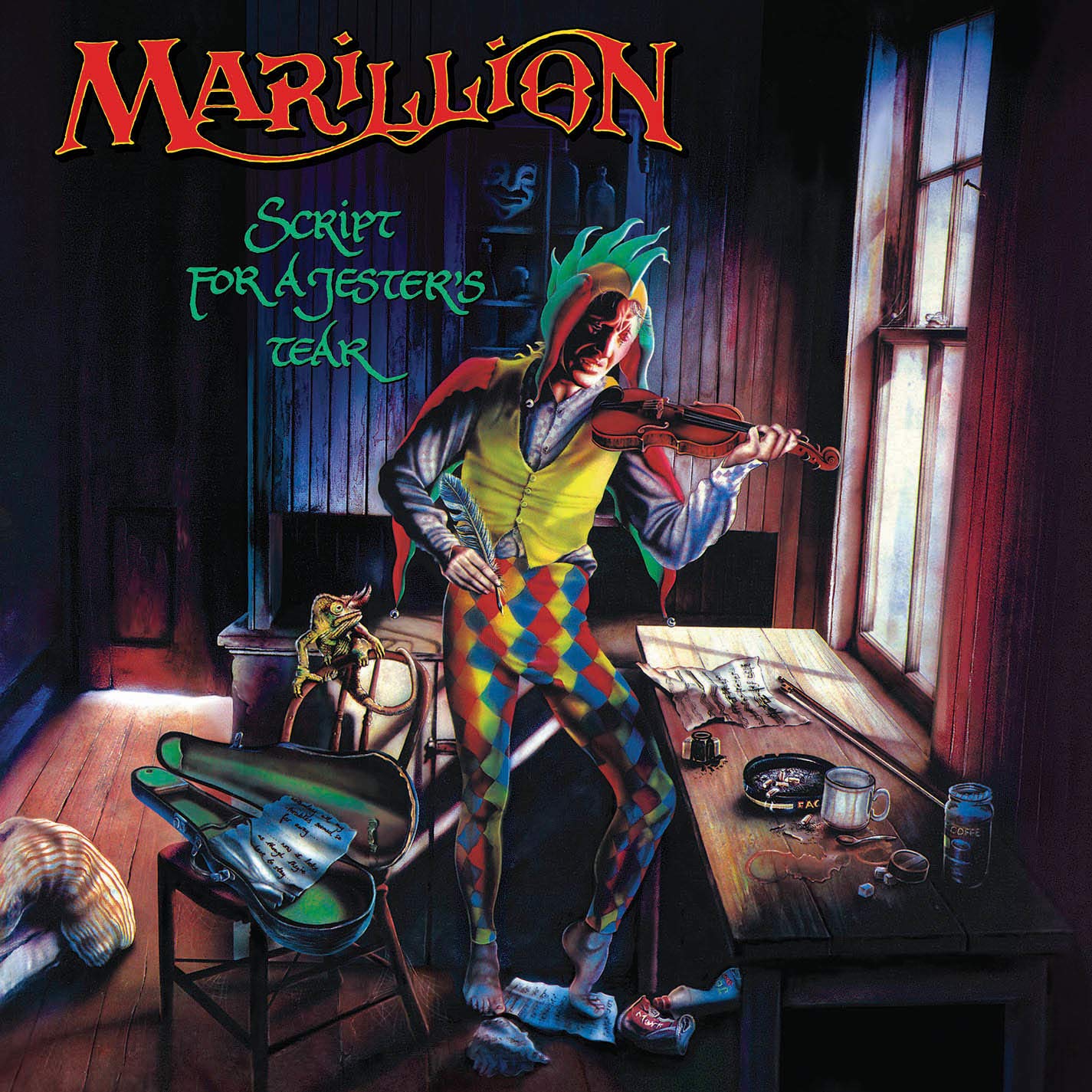
Marillion-Script For A Jester´s Tear (1983
With this album they debuted one of the greatest bands of the progressive neo; Marillion, a debut album that would achieve a perfect union with the sound of Peter Gabriel's Genesis and a style much more accessible to the general public.
It was also the album that would cause controversy among progressive rock fans, because they seemed like a clone of the aforementioned Genesis, with a pompous, complex, dynamic and harmonious rock.
Masterful songs like "Script For A Jester's Tear", "Chelsea Monday", "Forgotten Sons" or "Garden Party" are the perfect counterpoint for the commercial and more accessible "He Knows You Know",
They make up one of the paradigm albums of the 80s and a masterpiece of progressive neo.
It was also the album that would cause controversy among progressive rock fans, because they seemed like a clone of the aforementioned Genesis, with a pompous, complex, dynamic and harmonious rock.
Masterful songs like "Script For A Jester's Tear", "Chelsea Monday", "Forgotten Sons" or "Garden Party" are the perfect counterpoint for the commercial and more accessible "He Knows You Know",
They make up one of the paradigm albums of the 80s and a masterpiece of progressive neo.
Wednesday, May 20, 2020
Marillion-Misplaced Childhood (1985)
In 1985 Marillion released her third album "Misplaced Childhood", which would eventually become her best work and also the most popular and best-selling.
Conceptually devised, it deals with the most private and dark nightmares plus reconciliations with the love of its leader and singer Fish.
With this work the band reached its highest level of creativity and the ideal and absolute balance.
It is also the job where the band shows its maturity, after two great albums, but somewhat inconsistent.
The concept, its interpretive power, perfect harmony, poetic lyrics, cultured language and instrumental precision, made it one of the best albums in progressive rock and an instant classic.
Conceptually devised, it deals with the most private and dark nightmares plus reconciliations with the love of its leader and singer Fish.
With this work the band reached its highest level of creativity and the ideal and absolute balance.
It is also the job where the band shows its maturity, after two great albums, but somewhat inconsistent.
The concept, its interpretive power, perfect harmony, poetic lyrics, cultured language and instrumental precision, made it one of the best albums in progressive rock and an instant classic.
Wednesday, May 13, 2020
Marillion-Holidays in Eden (1991)
In this LP it can be said that Marillion had already become “another” formation very different from the one recorded by the four albums in studies with Fish. The giant singer's departure marked a before and after in the group's history; interestingly, as in other bands, people of a certain age tend to remember Marillion as "the Fish band", when in fact he was much less time than his replacement singer Steve Hoggart, nowadays. a talented man who never wanted to be an imitator or even a continuation of Fish, even though in the round he published with Marillion after the departure of Fish, the essential “Season's End”, that air could still be seen Marillion stale, so to speak.
The truth is that that old air disappears completely in this great work, a work that would already set the tone for later albums such as the incredible “Marbles” or “Brave”, although later Marillion's career fell into some low points of creativity, which is always excusable in some artists who have been publishing albums for so long.
"Holidays in Eden" contains some top themes, quiet themes of a soft and caressing atmosphere, if you think well above what they had done in the 80 groups that tried to convert to the melodic progressive like Saga or Barclay James Harvest, whose releases of those years are well below what Marillion achieved in this album. I recommend everyone to listen to songs as sublime as “The party”, exquisite, or the one that gives title to the album and from which a single was made in which –and this data in my view is curious- Hoggart appears with an image very similar to the one that Peter Gabriel had when he also experienced his changes and became, precisely again, a pop star. Thus, the destinies of Marillion, the artistic destinations, we mean, seem to be linked to the evolution of Peter Gabriel: avant-garde artists (to some extent, of course) in their beginnings, such as the Genesis of Peter Gabriel; and then in high octane pop band when Fish left them, just like Genesis when Phil Collins took command.
Tuesday, May 12, 2020
Marillion-Fear (2016)
Marillion over four decades have carved one of the best reputations in progressive rock and have done so with a lot of talent, knowing how to capture that heir sound of Genesis and then provide a more personal seal. The band has had two very different stages, one first with a great Fish and another with a talented Steve Hogarth. After the entrance of the latter, the band's music was adding more elements of their own, they moved away from the first-time patterns and became increasingly diverse, embracing different sounds to end up reinventing themselves gradually, getting to achieve sounds at many anthological moments.
Fear makes his 18 studio album, an album that seems to us apocalyptic where the band tells us the details about a world without morals and the coming storm.
Marillion here leaves us an extremely atmospheric but very intense album, with texts of clear political tendency. It is not a subject in which Marillion have remained on the sidelines throughout his career, but it is true that since the previous album the trend is even greater.
Recall that this trend had already begun in the Fish era since its inception with 'Forgotten Sons', 'Fugazi', 'White feather', 'White Russian' ... and had continuity in the Hogarth era with themes such as 'Easter', 'Gaza' - with all the controversy it generated - or the album 'Brave', one of his key points in his career, where they all brought out real-world problems.
Fear describes the world without morals where we have lived (corrupt political class, banks rescued by all citizens and that do not return what we put together, unscrupulous companies and the world of business without moral ...) . 'It is not an album for the generation of mp3', nor for those who were born with technology as the main communication "... they are for those who have their feet on the ground and do not allow themselves to be manipulated by current networks such as internet and fake news current.
The album contains three main suites with their corresponding movements: "El Dorado", "The Leavers" and "The New Kings", plus two somewhat shorter compositions with the titles "Living in FEAR" and "White Paper", in addition to a Little epilogue.
Monday, June 11, 2018
Marillion-Marbles (2004)
During the latter half of the 1990s, Marillion seemed to be preaching in the wilderness, releasing a series of rather predictable albums that would mark the lowest point creatively in their extensive discography. Albums like the unenthusiastic "Radiation" (1998), the predictable pop-rock "Marillion.com" (1999), and the more innovative "Anoraknophobia" (2001) left a certain unease among their more purist fans and a low commercial return, leading them to seriously reconsider their immediate future, convinced that this path was leading them nowhere. Thus, three years later they released "Marbles", a sprawling double album where they stepped outside their comfort zone to create one of their most consistent and progressive albums, meticulously delving into their musical origins with an intense and memorable neo-progressive sound. From epic progressive anthems like "Ocean Cloud" to the intense "Neverland", and from the melancholic "The Invisible Man" to the poignant "You're Gone" and "Fantastic Place", they demonstrated that they hadn't yet lost the essential original sound that had begun two decades earlier. However, there was also room for melodic and commercial soft rock, as exemplified by the catchy "Don't Hurt Yourself" and "Angelina". With this superb album (their thirteenth), Marillion entered a phase of great creativity, producing excellent works such as the subsequent "Happiness Is The Road" (2008), "Sounds That Can't Be Made" (2012), and "Fear" (2016).
Monday, July 17, 2017
Marillion-Clutching At Straws (1987)
Marillion's fourth album, and ultimately the last with their frontman and singer Fish, is undoubtedly their masterpiece, though it's somewhat overshadowed by the commercial success of its predecessor, "Misplaced Childhood". For this album, the band or rather, Fish returned to the concept album format, this time focusing on drugs and alcohol, substances Fish himself was struggling with at the time. Unlike "Misplaced Childhood", this new release lacks a strong musical cohesion. The connection lies more in the mature and coherent lyrics, which emphasize emotional states like sadness and resignation. All of this is captivatingly sung by a compelling Fish who seems to be crying out for help, and this recording appears to be the breaking point for his health (in fact, after recording it, Fish himself checked into a detox and rehabilitation center for a period of time). Musically, it's the perfect balance between progressive rock and more accessible sounds. There's more subtlety, with many emotional and atmospheric moments, where no single instrument overshadows another. The soft keyboards fit in perfectly, and the guitars are delightful, featuring excellent, melodic, and catchy solos. Another highlight is the unusual and significant cover, which, like the previous albums, was created by Mark Wilkinson. He subtly incorporated a different logo and a revealing image of the interior of the British pub Baker's Arms, with famous figures recreated by Wilkinson in the pub's interior scene. They all share a common denominator: serious problems with substance abuse, which they defended as an aid to their later creativity, or in other words, as a crutch to protect themselves from the surreal nature of fame. They are Robert Burns (Scottish national poet), who died at 37 from alcohol poisoning; Dylan Thomas (Welsh national poet), who died at 39 from the same cause; Truman Capote (writer and journalist, famous for his novel "Breakfast at Tiffany's"), who died at 59 from a fatal combination of alcohol, drugs, and pills (probably suicide); and Lenny Bruce (comedian and social satirist), who died at 40 from a heroin overdose. In addition to these, three more figures appear: John Lennon, James Dean, and Jack Kerouac (the first murdered, the second killed in a car accident, and the third from cirrhosis). All three shared the same philosophy of life: living almost on the edge. The stimulating and energetic "Hotel Hobbies" begins this journey through the experiences of Torch (a character portrayed by Fish himself in the third person), in the melodic "Warm Wet Cycle", where the dangers are narrated. From being trapped in the pub after work, all bathed in gentle guitar fills. The more pop-oriented and melancholic "That Time Of the Night" gives way to the atmospheric "Going Under", the energetic "Just For The Record", and the dynamic and politically charged "White Russian". Meanwhile, "Incommunicado" represents the album's most commercial moment, a powerful track with a devilishly addictive rhythm. The irresistible and melancholic "Torch Song", the forceful "Slainte Mhath", the enchanting "Sugar Mice", and the powerful and progressive "The Last Straw/Happy Ending" bring to a close an extraordinary album and a fitting end to Marillion's golden age.
Sunday, April 17, 2016
Marillion-Seasons End (1989)
Fish vs. Hogarth: this is undoubtedly one of the biggest catalysts for any discussion among Marillion fans, to the point that some online forums about the band categorically forbid even mentioning a comparison between these two singers, for fear of an electronic war that will clog up servers and computers. Beyond this exaggerated claim, it's relevant to the departure of the towering Fish and the arrival of Steve Hogarth as his replacement, and what Hogarth brought to Marillion, which was immense (and still is). Although the band's purists blame Hogarth for the group's musical shift towards a more pop-oriented sound, at the expense of the progressive grandeur of their early albums, the truth is that if there's one thing both sides agree on, it's his powerful voice, with its excellent range, and his talent as a great lyricist who invites reflection. All of this is clearly demonstrated on much of Marillion's first album after Fish and their first with Hogarth in the band, "Seasons End" from 1989. This was the first real testament to what the singer accomplished with Marillion as a band, and having said all that, "Seasons End" sounds brilliant and is undoubtedly an excellent and worthy successor to the superb album that preceded it with Fish in the lineup, "Clutching At Straws", released several years earlier. Right from its opening track, the incredible "King Of Sunset Town", it demonstrates the peak at which Marillion burst onto the scene and rise triumphantly, ready to begin another chapter, thus dispelling the doubts of those who predicted their downfall and eventual demise. The beautiful "Easter" is the singer's first major contribution to the group's repertoire, a track featuring one of Steve Rothery's best solos of his entire career and a rhythm as captivating as it is brilliant. The slow and mysterious “Seasons End” concludes with an epic and hypnotic finale that showcases the band's instrumental prowess. In “The Uninvited Guest”, we can already sense the direction of their new venture, a track that leans towards rock and commercial sounds with powerful guitar and bass lines. The melodic and heartfelt “Holloway Girl” is one of the album's lesser moments, while the nostalgic “Berlin” is a palpable demonstration of Hogarth's vocal excellence, a song as melancholic as it is dark, which, as it progresses, transforms into a powerful track with a stunning ending. After the short, acoustic “After Me”, comes the powerful, commercially oriented rock track “Hooks In You”, before concluding with the exquisite and progressive “The Space”, one of the album's most memorable moments and a fitting finale to Steve Hogarth's first major contribution to the Marillion universe.
Thursday, September 3, 2015
Marillion-Fugazi (1984)
Marillion's second album, and the first where they truly showcase their own style, moving away from the obvious Genesis influences of their debut. However, despite the band developing highly avant-garde instrumental sections characteristic of their own school, they don't lose sight of the classic sound that was present in their earlier work. For this new album, the band introduced a new drummer, Ian Mosley, who would fit perfectly into the instrumental cohesion of his bandmates. Furthermore, Fish's lyrics are more dynamic, and his vocal style doesn't delve into the vocal intonations of Peter Gabriel. The opening track, "Assassin", represents, in a way, Fish's particular vision of Eastern music an uplifting and energetic song with vigorous drumming, bass interludes, and great guitar riffs. The powerful “Punch and Judy” stands out as one of the most commercially viable yet hard-hitting tracks the band has ever recorded, brimming with powerful riffs, fabulous melodies, and a catchy hook that makes it utterly irresistible. Perhaps “Jigsaw” is the song that most closely resembles the Genesis style, a dark track with soaring passages and sublime guitar solos from Rothery. The superb “Emeral Lies”, with its sinister atmosphere and poetic lyrics, gives way to the brilliant and melodic “She Chameleon”, where the organ takes center stage. To finish the dynamic and progressive track, “Incubus”, which with smooth transitions between the different melodies within the same theme, makes it a superb and brilliant track and one of the fans' favorites in the group's live performances, and the more intimate and delicate “Fugazi”, a worthy conclusion to an extraordinary neo-progressive album, considered one of the masterpieces of the genre.
Sunday, January 6, 2013
Marillion-B´Sides Themselves (1988)
After four excellent albums with the Scottish giant Fish at the helm, Marillion had a wealth of unreleased material: B-sides, alternate versions, and previously unreleased live tracks. In 1988, they compiled all these "rarities" into one album, which, despite a title that somewhat undervalues its content, offers an enviable collection of valuable songs. "B'Sides Themselves" opens with the band's holy grail, the progressive epic "Grendel", a grandiose 18-minute monumental piece that, while perhaps a bit rough around the edges and not as sophisticated as their later work, is nonetheless a masterpiece. The album also features two re-recordings: "Market Square Heroes", another of their classic progressive anthems, and the haunting "Three Boats Down From The Candy". Among the rest are some of their early songs such as the attractive "Cinderella Search", "Lady Nina", "Freaks" or "Tux On", to end with the rocker "Margaret", which, when performed live, shows the progressive hard rock facet of the British band's early years.
Subscribe to:
Posts (Atom)