Showing posts with label Style: Progressive Heavy Rock. Show all posts

Saturday, July 18, 2026

Max Webster-Mutiny Up My Sleeve (1978)

With their third album, "Mutiny Up My Sleeve", Max Webster cemented their status as a key figure in the Canadian progressive hard rock scene. Although always somewhat overshadowed by more mainstream Canadian bands like Saga and Rush, Max Webster forged a strong reputation in their home country and even crossed borders, finding success in the North American and Japanese markets. "Mutiny Up My Sleeve" was the band's most reflective work to date, with clear progressive influences. Here, the band, led by Kim Mitchell, presented a less intriguing sound compared to their first two releases, while simultaneously crafting more mature and rewarding compositions. Songs like the rhythmic "The Party", the melancholic "Water Me Down", the stirring "Astonish Me", and the progressive "Beyond The Moon" propelled an album that would make a significant impact on the charts and definitively solidify the career of this formidable Canadian band.

Monday, June 15, 2026

Omega-200 Years After the Last War (1974)

"200 Years After the Last War" marked the end of the first era and the beginning of a new one for Omega, the quintessential Hungarian heavy hard rock band, emulating the progressive rock trend of the time. On this seventh release, hard rock, blues rock, and progressive rock follow in the footsteps of other British bands like Deep Purple and Uriah Heep, who were pioneering the style during those years. The album's highlight is the expansive "Suite", an intense 20-minute track where the pulsating mellotron and heavy rock guitar riffs, along with powerful vocals, drive one of the band's best compositions. Other standout tracks include the heavy rock anthem "Help to Find Me", the psychedelic "200 Years After the Last War", and the progressive hard rock track "You Don't Know". However, as with almost all Omega albums sung in English, it is the sometimes very poor lyrics and the difficult-to-understand lyrics that are the only drawback of this great progressive rock album from the mid-70s.

Friday, April 10, 2026

Elonkorjuu-Harvest Time (1972)

This Finnish quintet, founded in the late 1960s, enjoyed brief and modest success with their debut album, released in 1972 under the EMI label and titled "Harvest Time". In the 1970s, they released two albums, of which "Harvest Time" is considered a collector's item among music lovers, fetching between 500 and 1000 € for an original vinyl copy. Their second album, "Flying High, Running Fast" (1978), was released under the English name HARVEST, perhaps in the hope of achieving better international exposure. During those years, Elonkorjuu toured Northern Europe and frequently participated in major Finnish and Scandinavian rock events, such as the Pori Jazz and Ruisrock festivals. Although they disbanded in 1978, the band reunited in 2003 and released a new album, "Scumbag", the following year. This marked a shift in their musical direction, leaning towards a heavier rock-blues sound. In 2010, the band released the double live album "Scumbag Goes To Theatre", and in 2012, the 4-CD compilation "Seasons", which includes almost everything the band had recorded. But focusing on their debut album, Elonkorjuu delivers an ambitious hard rock effort with an appealing fusion of different genres such as blues, jazz, touches of folk, and subtle progressive sounds. Despite its somewhat lack of cohesion, it's a commendable album, deeply rooted in the typical sound of the late sixties. Tracks like the galloping “Unfeeling” and the muscular “Swords” showcase the power of the Hammond organ and the penetrating guitar riffs, while psychedelia permeates “Captain” and “Praise To Our Basement”, or the sinuous sounds of jazzy guitars and frenetic percussion, as demonstrated in the magnificent instrumental “Future”. The fast-paced rocker “Hey Hunter” and the schizophrenic “Old Man’s Dream”, along with the captivating “Me and My Fiend”, are other highlights of this magnificent, eclectic, energetic album, a real treat for fans of early hard rock from the late sixties. 

Wednesday, April 8, 2026

Bighorn-Bighorn (1978)

In the late seventies, pomp rock was experiencing its heyday in the United States. Bands like Styx, Kansas, Toto, Angel, Magnum, Boston and REO Speedwagon, among others, dominated the charts, and their albums were among the most acclaimed and best-selling. However, there were also many other bands operating in the underground scene, bands that didn't achieve the desired success or notoriety due to the dominance of these more famous and media-savvy bands, which unintentionally blocked their path to the charts. One of these was Bighorn, a band formed in the early seventies in Seattle, who had already released a single in 1974, "I Get High"/"Takin' Me Down", which went completely unnoticed. After a constant turnover of members, towards the end of the decade, this band embarked on an extensive tour of the western United States and southern Canada. They were fortunate enough to sign with a small Canadian label in Vancouver, a subsidiary of Columbia Records, who financed and released their first and only album in late 1978. On this debut, Bighorn showcased their AOR style fused with progressive hard rock sounds, highlighting their irresistible vocal arrangements and catchy, highly addictive, and commercially viable melodies. The lineup that recorded this album consisted of vocalist Bon Marcy, guitarist Joe Shikany, keyboardist Peter Davis, bassist Michael Ipsen, and drummer Steve Adams. Notably, all of them were also vocalists, a fact that greatly contributed to the superb vocal arrangements. Produced by Briton Martin Shaer, the album is a brilliant collection of tracks ranging from hard rock songs like "Triad Every Trick" and "Helen Betty" to melodic rock like "Stand Up" and "Mary-Anne", passing through more complex tracks such as "Sparrow" and "Penny For Your Dreams", not to mention catchy mid-tempo numbers like "(I Love You) I'm Not Afraid Anymore" or the progressive hard rock of "Star Rocker". After this album, some of its members decided to leave to pursue other projects, and Bighorn would ultimately disband at the end of 1979 without a trace, but leaving behind this brilliant and forgotten melodic rock album for posterity.

Wednesday, February 25, 2026

Polyphony-Without Introduction (1971)

Polyphony is a little-known American band that released only one album, "Without Introduction", now considered one of the gems of 1970s progressive rock. Polyphony was formed in 1971 in Virginia, and their artistic career was short-lived. Comprised of Glen Howard (lead vocals and guitar), Craig Massey (organ and synthesizers), Martin Ruddy (bass and vocals), Christopher Spong (drums), and Chatty Cooper (percussion), they created a solid and flawless work in which the sounds of the Hammond organ fused with guitar in the purest Jimi Hendrix style. That abrasive organ, along with the tremendous feeling of the guitar, and driven by the intense rhythms of the bass and drums, are present in the odyssey that is the dazzling instrumental "Juggernaut", the progressive "Arie's Flight", and the psychedelic "Crimson Dagger", all pieces where we hear echoes of the most symphonic and pretentious Emerson, Lake & Palmer or the most resounding King Crimson. Shortly after its release, the band dissolved without a trace, and their album became one of the most sought-after rarities for collectors. 

Thursday, February 29, 2024

Black Widow-Black Widow (1970)

With their second release, the British progressive heavy metal band Black Widow shed the satanic and gloomy lyrics of their previous album, but at the same time, they also lost the vitality and freshness of their music, delivering a more conventional and predictable work. This second album is composed of a mix of heavy progressive heavy metal pieces with more melodic ones, all driven by a visceral rhythm section, a prominent Hammond organ, and bluesy and funky guitar riffs. The album's opening couldn't be more promising with the hard rock/blues track "Tears and Wine", an interesting song with dynamic interplay between the guitar riffs and the Hammond organ. This is followed by less compelling tracks such as the bittersweet "The Gypsy," the rock and roll "When My Mind Was Young", and the uneven "The Journey", three songs that show a certain lack of inspiration, creativity, and instrumental development. On the other hand, the most outstanding tracks on an album that, despite not creatively surpassing its tremendous debut, is an interesting collection of typical heavy hard rock songs from the early 70s, are the powerful blues rock "Poser", the sinister and moving "Mary Clark", the heavy rock "Wait Until Tomorrow" and the galloping progressive jazz "Legend of Creation".

Thursday, August 17, 2023

Uriah Heep-Live (1973)

The 1970s were undoubtedly the era that saw the release of some of the greatest and most legendary live albums in rock history. This period showcased the instrumental and stage prowess of hundreds of bands, and "Uriah Heep Live" is one of those iconic double live albums. Recorded with the band's classic lineup in Birmingham in early 1973, while touring in support of "The Magician's Birthday", it presents Uriah Heep at their creative and artistic peak, demonstrating that they were a perfectly oiled machine of progressive hard rock. The live performance features Mick Box's fiery guitar riffs and his powerful interplay with Ken Hensley's Hammond organ, Kerslake's frenetic drumming, and the breathtaking vocals of an apotheosis of passion from David Byron, alongside the vocal and instrumental excellence of bassist Gary Thain. Classics like "Easy Livin' ", "July Morning", "Traveller in Time", "Gypsy", and the majestic "Circle of Hands" feature reworked versions that are longer than the original studio recordings, yet retain their distinct identity. "Uriah Heep Live" is one of the essential live albums in history, a true classic that perfectly captures the essence of the legendary band Uriah Heep on stage.

Friday, June 30, 2023

Electric Food-Electric Food (1970)

From the ashes of the German band Lucifer's Friends emerged Electric Food, who, with a powerful style of psychedelic hard rock, released several albums in the early 1970s. The band consisted of Peter Hesslein (guitar and vocals), Peter Hecht (keyboards), Hans-Joachim Rietenbach (drums), Dieter Horns (bass), and Georg Mavros (vocals). Their debut album features some excellent covers, beginning with a frenetic rendition of Led Zeppelin's "Whole Lotta Love", followed by the traditional "House of the Rising Sun", popularized by The Animals, and the boogie-rock track "Let's Work Together" by the ever-popular Canned Heat. Among their own compositions, highlights include the psychedelic "The Reason Why", the progressive "Hey Down", the blues-rock "Tavern", the dark heavy-rock "Nosferatu", the galloping "Icerose", and the heavy hard-rock "Twelve Months and Day".

Tuesday, February 28, 2023

Pavlov´s Dog-Pampered Menial (1975)

Considered a cult band, Pavlov's Dog was founded in the early 1970s in St. Louis, USA, and played a pure progressive rock that combined elements of folk and hard rock. Their debut was the impressive "Pampered Menial" in 1975, which is also undoubtedly their best work, showcasing the talent of the band led by guitarist Steve Scorfina. Along with singer David Surkamp, ​​drummer Mike Safron, bassist Rick Stockton, keyboardists David Hamilton and Doug Rayburn, and violinist Siegfried Carver, the band comprised the lineup. On this first album, the band perfectly combined beautiful compositions with the immense talent of all its members. With a powerful start to the track "Julia", where acoustic and symphonic elements blend sublimely, the band showcases its diverse sounds, such as "Late November", where they display a heavier edge with great guitar riffs, or the apotheotic and rhythmic "Song Dance", which leads us to "Fast Gun", "Natchez Trace", and "Theme from Subway Sue", where we can appreciate the group's eclectic sound. The album concludes with the instrumental "Preludin" and the progressive "Of Once and Future Kings", which becomes the grand finale of one of the great progressive albums of the 70s, as worthy and magnificent as the masterpieces of the genre from that era.

Sunday, February 5, 2023

Lucifer´s Friend-Banquet (1974)

The history of the German band Lucifer's Friend has been marked by diverse musical directions. They were never content to remain within a single defined style, but rather always preferred to explore new avenues with each subsequent album. They navigated brilliantly from the heavy prog of their roots to hard rock, passing through jazz rock, though always with a clear progressive perspective. In 1974, the band released their fourth album, "Banquet", where they moved away from the heavy sounds of their first two albums to delve into the realm of jazz rock, but without definitively abandoning their heavy rock roots. The compositions on this album remain powerful but with a different nature, partly replacing the sharp, dark guitar riffs with the sounds of electric piano, synthesizers, string instruments, and elaborate brass arrangements. Here, the guitars are more focused on solos than riffs, and the fact that pure hard rock is almost entirely absent does not mean that the overall tone of the album is any less powerful. Tracks like "Spanish Galleon" or "Sorrow" are a clear example of that orientation towards the realms of jazz rock, while "Thus Spoke Oberon" is closer to classic progressive rock, and in a similar tone appears the energetic and baroque "Dirty Old Town", with which they ended a muscular and forceful album, almost as much as any of the best hard rock albums of the time.

Saturday, January 7, 2023

Blackwater Park-Dirt Box (1972)

Another German band that succumbed early in the rock world was Blackwater Park. Despite releasing a remarkable progressive hard rock album, they unfortunately failed to achieve commercial or media success in their time. Founded in Berlin near the end of 1971, their original lineup consisted of guitarists and vocalist Richard Routledge and Michael Fechner, drummer Norbert Kagelmann, and bassist Andreas Scholz. Thanks to the German label BASF, they recorded their only album in 1972, "Dirt Box", which showcases their musical preferences for hard rock. Raw, incisive guitar riffs, the occasional Hammond organ, and a progressive undercurrent with psychedelic touches propel a series of commendable songs within a melodic and catchy framework. That progressive and psychedelic avant-garde is present in "Rock Song", while the heavy "Roundabout", the psychedelic "One's Life", the bluesy "Indian Summer" or the melodic rock "Mental Block", make up a very good work that would go totally unnoticed until many years later, when the Swedish progressive metal band Opeth, would rescue them from oblivion by titling their fifth album in their honor "Blackwater Park" (2001).

Saturday, December 24, 2022

Magnum-On A Storyteller´s Night (1985)

With cover art that perfectly reflects the music within, Magnum's fifth album, "On A Storyteller's Night", became one of their best works, perfectly capturing their addictive style that brilliantly blends epic, melodic rock, and progressive structures. It's replete with great keyboard passages, courtesy of Mark Stanway, the powerful hard rock guitars of Tony Clarke, and the impressive vocals of singer Bob Catley. From the energetic "Just Like An Arrow" to the melodic "The Last Dance", passing through the infectious "Endless Love", the AOR "Two Hearts", and the epic and glorious "Haw Far Jerusalem", Magnum showcased their great musical diversity, producing everything from semi-progressive albums like "Chase The Dragon" and "Wings Of Heaven" to clear concessions to high-quality melodic rock such as "The Eleventh Hour", "Vigilante", and "Goodnight L.A".

Tuesday, May 17, 2022

Aragorn-The Suite (1973)

Aragorn's short career lasted only a few months, just enough time to record an album that was initially released in a limited edition of fifty copies, until many years later it was rediscovered and reissued on CD. This Australian band was led by a talented classically trained musician named Oleg Dietrich, who in 1967 had begun composing a work called "The Suite", influenced by the book "The Lord of the Rings". Years later, he finished most of the composition and formed a band called Aragorn to record and officially release it. With a fully established lineup, they recorded "The Suite", a record that draws directly from the roots of British progressive rock with echoes of medieval folk and jazz. The work displays great intensity, with a sober and complex composition, featuring dense passages in a series of fluid, separate pieces that result in a hidden masterpiece of progressive rock.

Monday, February 21, 2022

Cargo-Cargo (1972)

Cargo were a fleeting Dutch heavy prog band, who only recorded one album published in 1972, which is full of overwhelming and dynamic sounds that, by way of guitar jams, is another of those amazing lost and dark albums from the 70's.
This band arose from the ashes of another Dutch band called September, which had released several unsuccessful singles in the early 70's and would later change their name to Cargo. Their lineup consisted of brothers Ad and Jan de Hont, both guitarists, bassist Willem DeVires, and drummer Denis Whitbread.
This unique work contains four extensive cuts where the guitar lines are intermingled with frenetic guitar duos in unison in the purest style of the British Wishbone Ash.
Due to the long duration of the four tracks, there is enough room for improvisation with powerful riffs, acid sounds, solos of all kinds and a mind-blowing electric jam style, all infused with melodic vocals.
The initial "Cross Talking" as its title implies, is a formidable theme of incredibly executed dual guitars and a powerful rhythm section that perfectly supports the feeling that it is played live. "Summerfair" is a fifteen minute tour de force with relaxing sounds, lots of improvisation and sweeping psychedelic sounds. While "Sail Inside", it begins with a powerful hard rock that ends in another instrumental jam.
However, and despite the fact that they had a good impact on the part of the critics, the album would go unnoticed due to the scarce promotional support from their record company, being relegated to the most absolute ostracism, which is why the band would disappear at the end of 1972, but leaving For posterity, another essential album in the history of European progressive rock of the 1970s.

Saturday, November 7, 2020

Uriah Heep-The Magician´s Birthday (1972)
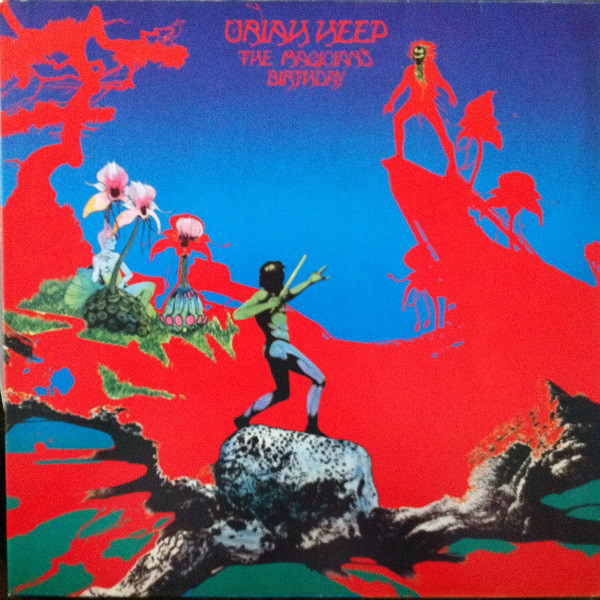
Following the line started in "Demons and Wizards" that same year of 1972, Uriah Heep published "The Magician's Birthday", barely 7 months apart and in which Roger Dean was once again in charge of the design of the cover album.
If in the previous work the band had conscientiously worked its sound, taking it to progressive levels, but without taking away an iota of commerciality, here the sounds are even more dense and dramatic, with a less heavy and complex style, placing great emphasis on the facet commercial.
However, none of this detracts from their unmistakable sound while preserving the hallmarks of Uriah Heep that remain unchanged, the beautiful harmonies of "Rain" and "Blind Eye", contrast with powerful rock such as "Sweet Lorraine" the rhythmic "Spider Woman", the emotional "Tales", the anthological "Sunrise" or the progressive "The Magician's Birthday", which make up a masterful album worthy successor to that masterpiece that is "Demons and Wizards".

Tuesday, October 13, 2020

Atomic Rooster-Death Walks Behind You (1970)

One of the most formidable progressive rock formations in history has been Atomic Rooster, although its status is at the level of a cult band overshadowed by the greats of the genre that emerged during that era and had much more continuity than this.
Formed by Vicent Crane in 1969 like his ex-band Crazy World Arthur Brown, for this he recruits incipient drummer Carl Palmer, bassist Nick Graham and guitar John Du Cann and after having played with Deep Purple they get a contract with the B&C Records label with which they record their first album "Atomic Rooster", a superb work of progressive hard rock.
But after this magnificent work, desertions began and Carl Palmer left the group to found together with Keith Emerson and Greg Lake the mythical EL&P and for his part Graham did the same to found the band Skin Alley.
With a new line-up where besides Crane and Cann were the drummer Paul Hammond, they record their best album "Death Walks Behind You", considered one of the top works of progressive rock.
With a bombastic and far-fetched sound and where the virtuosity of its components together with the force and forcefulness leave us one of the germinal albums of progressive hard.

Friday, September 11, 2020

Argent-Circus (1975)

The departure of Russ Ballard from the British band Argent meant losing not only one of their best songwriters, but also their lead singer and guitarist. However, desperate times call for desperate measures, and this loss led the band's other leader, Rod Argent, to take the reins musically and steer the band in a direction and sound more in line with his preferences and musical tastes. To begin with, he recruited not just one singer and guitarist, but two at the same time: John Verity and John Grimaldi. This substantial transformation considerably changed Argent's style. "Circus" was the perfect excuse for Rod Argent to delve into more jazz-influenced atmospheres, while simultaneously crafting an album far more progressive and balanced than all their previous releases, completely abandoning the hard rock of their early records. Here, the Hammond organ (omnipresent on all previous albums) practically disappears in favor of the Mellotron, the mini Moog, and Fender Rhodes pianos, as demonstrated in the atmospheric "Clown". All these changes are also reflected in the great sense of dynamics and brilliant rhythmic shifts, as in the exuberant symphonic title track, the fiery progressive "Highwire", and the jazz-rock "Trapeze", which represent the album's most avant-garde moments. Meanwhile, the accessible sounds of yesteryear are present in the melodic "Shine On Sunshine" and the cheerful boogie-jazz "The Jester".

Wednesday, September 9, 2020

Eloy-Metromania (1984)

In the eighties the German band Eloy, had adapted to the new times and the sounds of a new age, they had left behind their progressive rock with krautrock influenced, long developments and prog structures to focus on progressive pop of quality with well structured themes but without progressive complexity.
From this era are the albums "Planets" (1981), "Time to the Turn" (1982), "Perfomance" (1983) and "Metromania" (1984).
All of them followed a common denominator, a greater role for synthesizers, very powerful rock guitars, a more accessible sound and songs of contained duration.
"Metromania" that had another spectacular cover designed by Rodney Matthews, had a timid response from the critics, however it was better received than the previous "Perfomance" by its fans.
His songs included the progressive and hypnotic "All Life is One", the heavy rock "Nightriders" or the progressive bluesy "The Stranger".

Sunday, May 24, 2020

Triumph-Allied Forces (1981)

This formidable power trio, despite always being somewhat overshadowed by their compatriots Rush, has produced a discography brimming with vigorous and intense hard rock, with forays into progressive rock, for nearly two decades. Throughout this time, they showcased spectacular stage presence and immense instrumental virtuosity from their three members: Rik Emmett (guitar and vocals), Gil Moore (drums and vocals), and Mike Levine (bass and vocals). In 1981, they released "Allied Forces", their fifth album, in which the Canadian band perfectly reflects their hard rock roots, their more melodic side, and their progressive influences. On this release, Rik Emmett demonstrates his masterful guitar playing alongside his melodic vocals, while percussionist Gil Moore delivers the most crushing and energetic tracks. Powerful tracks like “Fool For Your Love” and “Allied Forces” stand in stark contrast to the more accessible “Magic Power” and “Say Goodbye”, while the phenomenal “Fight The Good Fight” and “Ordinary Man” represent the album's most complex and progressive moments. For all these reasons, this fifth album became one of Triumph's greatest creative achievements, garnering immense success with over a million copies sold in the North American market, earning a platinum record and considerable sales in Canada and Europe.

Sunday, March 24, 2019

Captain Beyond-Sufficiently Breathless (1973)

After their stunning debut, the band led by Rod Evans fully embraced the sounds of avant-garde rock with "Sufficiently Breathless", a departure from the powerful hard rock of their first album. In this new release, progressive elements appear throughout, showcasing greater compositional maturity, more imaginative work, and even enhanced instrumental technique. All these changes are foreshadowed from the start with the progressive title track, which nevertheless retains the signature effective riffs, splendid vocals, and refined instrumentation. But they soon shift into high gear, revealing their energetic side with the surprising rock of "Starglow Energy", the addictive mainstream hit "Bright Blue Tango", the rock fusion of "Drifting In Space", and the powerful "Everything's A Circle". In short, with their second release, the band formed by the aforementioned Rod Evans (vocals), Larry Reinhardt (guitars), Guille Garcia (percussion), Marty Rodriguez (drums), Lee Dorman (bass) and Reese Wynans (keyboards), wanted to expand their style by producing an album that, although initially rejected by their most purist fans, is also true to be one of the most meritorious cult works of the early 70s.